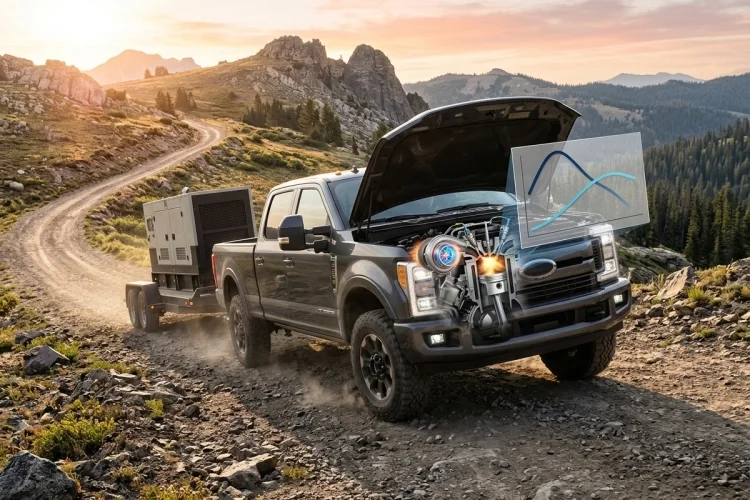
Press the accelerator in a diesel truck or SUV, and you may notice an immediate, muscular pull-even when the engine is not revving very high.
That strong low-speed response is one reason diesel engines are widely used in commercial vehicles, agricultural machinery, generators, and cars designed for towing. But why do diesel engines produce more torque than many comparable petrol engines?
The answer is not simply that diesel fuel is “more powerful.” Torque depends on cylinder pressure, engine geometry, airflow, fuel injection, turbocharging, and how the engine is tuned.
Diesel engines compress air strongly before injecting fuel. This compression-ignition process allows them to operate efficiently under high cylinder pressures.
Many diesels also use turbochargers, long-stroke designs, and fuel systems calibrated to produce their strongest output at relatively low engine speeds.
Not every diesel automatically produces more torque than every petrol engine. However, when engines of similar size or purpose are compared, diesel designs commonly prioritise low-RPM pulling force rather than high-RPM horsepower.
What Is Engine Torque?
Torque is a twisting force. Inside an engine, combustion pushes a piston downward, the connecting rod transfers that force, and the crankshaft turns.
The force applied to the crankshaft creates engine torque. It is usually measured in pound-feet in the United States or newton-metres in metric markets.
You can think of torque by imagining a wrench. A longer wrench makes it easier to turn a tight bolt because the force is applied farther from the bolt’s centre. A crankshaft works according to a similar basic principle.
Torque is different from horsepower. Horsepower describes how quickly an engine can deliver its twisting force. The relationship is commonly expressed as:
Horsepower = Torque × RPM ÷ 5,252
An engine producing 400 pound-feet at 2,000 RPM generates approximately 152 horsepower at that point. A petrol engine can produce similar horsepower with less torque if it operates at a much higher RPM.
Higher Compression Creates Strong Cylinder Pressure
The first major reason diesel engines produce strong torque is their high compression ratio. During the compression stroke, the piston squeezes air into a very small area.
This compression raises the air’s pressure and temperature. Diesel fuel is then injected into the hot compressed air, where it ignites without requiring a conventional spark plug.
Higher compression ratios can support efficient combustion and substantial cylinder pressure. That pressure acts on the piston crown, creating the force that turns the crankshaft.
Diesel engines must therefore be built to tolerate demanding internal loads. Their blocks, crankshafts, pistons, connecting rods, bearings, and cylinder heads are often designed with strength and durability in mind.
Cummins explains that advanced diesel engines use high compression ratios as part of a design that supports increased torque, power, and overall efficiency.
However, compression ratio alone does not determine output. Combustion timing, boost pressure, engine displacement, airflow, and fuel quantity must also be carefully controlled.
Diesel Engines Are Usually Tuned for Low RPM
Petrol performance engines often generate their highest horsepower by maintaining torque at high engine speeds. Diesel engines generally operate within a lower RPM range.
Rather than continuing to rev toward 6,000 or 7,000 RPM, many road-going diesels deliver peak torque somewhere in the low or middle part of the rev range. This makes strong pulling force available without requiring the driver to accelerate the engine dramatically.
That characteristic is valuable when moving a heavy vehicle from a standstill, climbing a hill, towing a trailer, or carrying cargo. The engine can provide useful force while operating at a relatively relaxed speed.
Diesel combustion does not happen instantly. Fuel must be injected, atomised, mixed with hot air, and burned. As engine speed rises, there is less time available for this process during each cycle.
Large diesel components may also be heavier because they must withstand high compression and combustion pressure. Greater moving mass can make extremely high RPM less practical.
Manufacturers therefore tend to optimise diesel engines for a broad, strong torque curve rather than an exceptionally high rev limit.
Turbocharging Pushes More Air Into the Cylinders
Most modern automotive diesels use a turbocharger. The turbo captures energy from exhaust gases to drive a compressor, which pushes additional air into the engine.
More air means more oxygen is available. The fuel system can then inject a larger amount of diesel while maintaining suitable combustion conditions, producing stronger cylinder pressure and more torque.
Turbocharging is particularly effective because a diesel engine normally controls power through fuel delivery rather than heavily restricting its intake air with a throttle. Additional boost can therefore support substantial low- and mid-range output.
Cummins identifies turbocharging as one of the features that helps diesel engines combine high torque with useful horsepower.
Many engines use variable-geometry turbochargers. These systems adjust the flow of exhaust gases toward the turbine, helping the turbo respond at lower RPM while still supporting airflow as engine speed increases.
An intercooler is also commonly fitted. Compressing air raises its temperature, so the intercooler cools it before it reaches the cylinders. Cooler air is denser and contains more oxygen per unit of volume, supporting consistent combustion.
Stroke Length and Crankshaft Leverage Matter
Engine stroke is the distance a piston travels between the top and bottom of its cylinder. Many diesel engines-especially those designed for trucks and industrial use-use relatively long strokes.
A longer stroke can increase the crankshaft’s effective leverage. Like using a longer handle on a wrench, applying combustion force farther from the crankshaft’s centre can help create greater turning force.
Longer-stroke engines also tend to favour low-speed output. They can produce useful torque without relying on very high RPM, which suits towing, hauling, and commercial operation.
However, it would be misleading to say that every diesel is long-stroke or that stroke length alone creates torque. Bore size, connecting-rod geometry, cylinder pressure, displacement, airflow, and calibration all influence the result.
A long stroke can also increase average piston speed at a given RPM. That is another reason many diesel engines have lower maximum engine speeds than short-stroke petrol performance engines.
The overall design represents a compromise. Engineers choose dimensions that provide the desired balance of torque, efficiency, durability, size, and operating speed.
High-Pressure Fuel Injection Controls Combustion
A modern diesel engine does not simply spray a large amount of fuel into each cylinder. Its common-rail injection system delivers carefully measured fuel at extremely high pressure.
Bosch diesel systems can operate at pressures reaching 2,500 bar or more, depending on the application. High pressure helps break the fuel into tiny droplets so it can mix effectively with compressed air.
Modern injectors may perform several separate injections during one combustion cycle. A small pilot injection can reduce noise, while the main injection produces most of the useful force. Additional injections may support emissions control or smoother operation.
The injection system can adjust when fuel enters the cylinder, how quickly it is delivered, and how much is supplied. Bosch notes that common-rail systems provide significant flexibility over injection pressure, timing, quantity, and duration.
This precision lets engineers shape cylinder pressure rather than allowing it to rise uncontrollably. When calibrated correctly, the engine can produce strong low-speed torque while managing noise, fuel consumption, mechanical stress, and exhaust emissions.
Engine Displacement and Heavy-Duty Construction
Many diesel engines are designed for applications that naturally require large displacement. A larger total cylinder volume allows the engine to take in more air and burn more fuel during each cycle.
That can produce greater combustion force and torque. This is one reason a large commercial-truck diesel develops far more pulling force than a small passenger-car petrol engine.
Heavy-duty diesel engines are also designed to sustain high loads for long periods. A commercial vehicle may spend hours climbing gradients, transporting cargo, or operating close to its rated output.
For example, Cummins lists versions of its X10 diesel with outputs ranging from 320 to 450 horsepower but torque ratings reaching 1,650 pound-feet. The large difference between its horsepower and torque figures reflects an engine designed to provide substantial force at comparatively low speeds.
This does not mean weight and strength create torque directly. Instead, stronger components allow the engine to tolerate the high cylinder pressure required to produce and sustain it.
The trade-off is that diesel engines can be heavier, more complex, and more expensive than simpler petrol units.
The ECU Shapes the Torque Curve
Modern engine torque is managed electronically. The engine control unit receives the driver’s accelerator request and calculates how much torque the powertrain should produce.
It then coordinates fuel quantity, injection timing, boost pressure, exhaust gas recirculation, airflow, and other systems. Bosch describes torque as a key criterion used by an electronic engine control unit when implementing engine requirements.
Manufacturers can therefore give two versions of the same basic engine different torque ratings through software and supporting hardware. The calibration may limit output to protect the transmission, clutch, cooling system, emissions equipment, or drivetrain.
Some automatic transmissions can handle only a particular amount of torque. Even when the engine could technically produce more, the ECU may reduce output in lower gears or during shifts to protect components.
This is also why aftermarket tuning must be approached carefully. Increasing boost and fuel delivery may raise torque, but it also increases cylinder pressure, exhaust temperature, and stress on the engine and transmission.
Why Torque Makes Diesels Good for Towing
Strong low-RPM torque helps a vehicle start moving when it is carrying significant weight. The driver does not have to keep the engine at very high speed to access useful pulling power.
This characteristic also helps on hills. When road speed falls, the engine may remain within its strongest torque range without needing frequent high-RPM gear changes.
The transmission and final-drive ratio still play major roles. Engine torque is multiplied through the gearbox before it reaches the wheels, so a lower gear can create much greater wheel torque than a higher one.
A diesel engine’s torque figure alone therefore does not determine towing capacity. Vehicle structure, brakes, cooling, tyres, transmission design, suspension, axle ratings, and manufacturer certification are equally important.
Still, the combination of low-speed torque, efficiency under load, turbocharging, and durable construction makes diesel power particularly suitable for demanding work.
Diesel engines usually produce more torque because their designs combine high compression, strong cylinder pressure, turbocharged airflow, precise fuel injection, and low-RPM calibration.
Many also use long-stroke geometry and larger displacement to create substantial crankshaft force without relying on extreme engine speed. The result is the muscular pulling sensation associated with diesel trucks, vans, and towing vehicles.
However, diesel does not automatically beat petrol in every comparison. Engine size, boost, intended use, gearing, and electronic tuning all affect the outcome. When comparing vehicles, look beyond the peak torque figure.
Check where that torque is produced, how broad the power band is, and whether the transmission can use it effectively. Take a test drive under realistic conditions to discover whether a diesel engine’s low-speed character genuinely suits your needs.