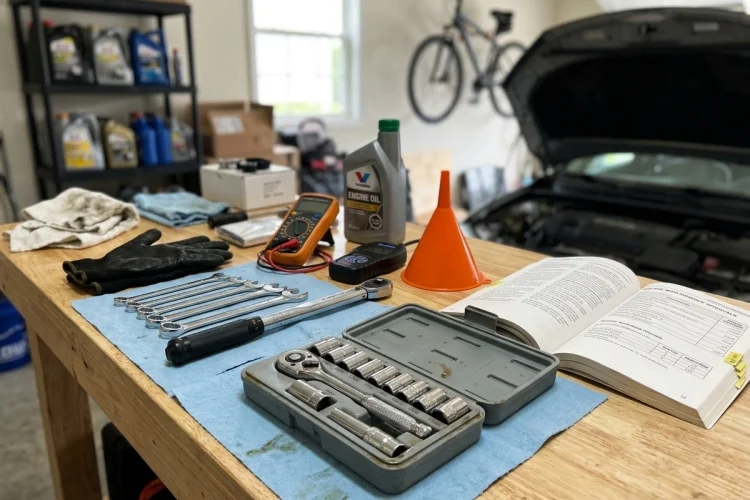
Looking after your car’s engine does not mean turning your garage into a professional workshop. With a small collection of reliable tools, you can check fluid levels, replace filters, change engine oil, inspect components, and investigate basic warning lights at home.
The difficult part is knowing what belongs in a beginner’s toolbox. Tool shops sell hundreds of sockets, scanners, extractors, gauges, and specialised devices, but most car owners only need a carefully selected core kit.
The essential tools for basic engine maintenance should help you work accurately, safely, and without damaging fasteners or components. A proper socket is better than forcing an adjustable wrench onto a bolt, while a torque wrench is safer than tightening everything as hard as possible.
Your vehicle’s owner’s manual should guide every job. It identifies the correct fluids, capacities, service procedures, lifting points, and sometimes the tools required. Manufacturer guidance also reminds owners that some repairs require specialist knowledge and equipment.
Here is what you should consider adding to your first engine-maintenance toolkit.
Start With the Owner’s Manual and a Safe Workspace
The owner’s manual may not look like a tool, but it is one of the most important resources in your kit. Before opening a drain plug or removing a filter, check the recommended procedure for your specific model.
Cars use different fastener sizes, fluid specifications, oil capacities, and tightening values. A method that works on one vehicle may cause damage on another.
You should also work on firm, level ground with good lighting and ventilation. Allow hot engine components to cool before touching the exhaust manifold, radiator, coolant cap, spark plugs, or engine oil.
Keep loose clothing, jewellery, hair, and tools away from belts, pulleys, and cooling fans. Some electric fans can operate unexpectedly, even when the engine is not running.
A rechargeable work light or head torch is useful because many engine components are hidden beneath covers, pipes, and wiring. Good visibility helps you notice leaks, damaged connectors, loose clamps, and fasteners that might otherwise be missed.
Build a Core Set of Hand Tools
A basic socket set is the foundation of most DIY engine-maintenance work. It allows you to remove engine covers, battery terminals, air-filter housings, drain plugs, brackets, and many other fasteners.
Choose a set that matches your vehicle. Most modern cars use metric fasteners, although some vehicles and aftermarket parts may also require imperial sizes.
A 3/8-inch-drive ratchet is a practical general-purpose choice. Smaller 1/4-inch tools are useful in tight spaces, while a 1/2-inch drive is intended for larger, more heavily tightened fasteners.
Deep sockets can reach nuts on longer studs, while extension bars help access bolts positioned beneath hoses or covers. A universal joint or flexible extension can be useful when the ratchet cannot line up directly with the fastener.
You should also own a set of combination spanners. These are helpful when a socket will not fit or when one fastener must be held while another is loosened.
Add several screwdrivers, including flat-blade and Phillips types. Modern cars may also use Torx, hex, or other specialised fasteners, so inspect your vehicle before buying extra bits.
Pliers, long-nose pliers, and hose-clamp pliers are useful for clips, clamps, small connectors, and awkward components. Avoid using pliers as a substitute for the correct socket because they can round the edges of a fastener.
Use a Torque Wrench for Accurate Tightening
Many beginners assume that a bolt should be tightened until it feels secure. Unfortunately, “tight enough” is difficult to judge accurately.
A torque wrench allows you to tighten a fastener to a specified value. This is particularly useful for spark plugs, oil drain plugs, engine covers, intake components, and other parts that can be damaged by excessive force.
Overtightening a drain plug can strip the threads in the oil pan. Applying too much force to a spark plug may damage its threads, while insufficient tightening can prevent it from sealing correctly.
Torque specifications vary between engines, so obtain the correct figure from reliable service information. Do not copy a value from a different model simply because the component looks similar.
A click-type torque wrench is a practical option for beginners. Use it only for final tightening rather than as a breaker bar for loosening stubborn bolts.
Store an adjustable torque wrench according to its manufacturer’s instructions, usually at its lowest marked setting rather than under tension. Proper care helps maintain its accuracy.
Gather the Right Tools for Oil Changes
An engine oil change is one of the most common maintenance jobs performed at home. It requires more than a bottle of fresh lubricant.
You will normally need a suitable wrench or socket for the drain plug, an oil-drain container, a funnel, a replacement filter, and the correct engine oil. Toyota gives a similar basic list while stressing that procedures and specifications vary by vehicle.
An oil-filter wrench may be required if the old filter cannot be removed by hand. Different filters use different tools, including strap wrenches, plier-style tools, and cup-shaped filter sockets.
Choose an oil pan with enough capacity for the complete contents of your engine. A sealed drain container makes transporting used lubricant to a recycling facility easier and cleaner.
A funnel reduces spills when adding new oil. Keep it clean and store it in a sealed bag so dust does not enter the engine during the next service.
Disposable absorbent pads, shop towels, and a drip tray are also useful. Clean spills quickly, especially when oil reaches belts, electrical connectors, or the ground.
Use the exact oil viscosity and performance specification listed by the manufacturer. API certification marks and service categories can help identify compliant products, but the owner’s manual remains the primary guide.
Add Simple Inspection and Fluid-Check Tools
Many engine problems can be spotted through regular visual inspections. A few inexpensive tools make these checks easier.
A clean lint-free cloth is useful when checking an engine-oil dipstick. Keep separate cloths for oil, coolant, and general cleaning so different fluids are not accidentally mixed.
A small inspection mirror lets you look behind hoses, underneath components, and around the rear of the engine. Pair it with a bright torch to search for wet areas, cracked rubber, corrosion, or loose connections.
A flexible magnetic pickup tool can retrieve a nut or socket dropped into the engine bay. It may save you from removing several components just to recover one small metal object.
A tyre-pressure gauge is not an engine tool, but it belongs in every basic maintenance kit because tyre pressure affects safety, handling, and vehicle efficiency. NHTSA also recommends carrying basic repair tools as part of general vehicle preparation.
For coolant checks, you normally need only good lighting and the level markings on the expansion tank. Never remove a pressurised cooling-system cap while the engine is hot.
Avoid using the same funnel for oil, coolant, fuel, and brake fluid. Even a small amount of contamination can create problems, so label each fluid tool clearly.
Use an OBD-II Scanner for Basic Diagnostics
An OBD-II scanner connects to the vehicle’s diagnostic port and reads information stored by the engine computer. It is especially useful when the check engine light appears.
A basic code reader can retrieve diagnostic trouble codes and erase them after a repair. More advanced scanners display live information such as coolant temperature, engine speed, airflow readings, fuel corrections, and oxygen-sensor activity.
The EPA describes hand-held scan tools as devices that can request emissions-related powertrain trouble codes and provide diagnostic assistance.
However, a code does not automatically identify the part that must be replaced. For example, a lean-mixture code could be caused by an intake leak, weak fuel pressure, contaminated sensor, injector problem, or exhaust leak.
Use the scanner to collect evidence, not to guess. Record every code and its freeze-frame data before clearing anything.
An inexpensive reader is enough for basic warning-light checks. Professional-level scanners become valuable when working with manufacturer-specific modules, bidirectional controls, or detailed electrical diagnosis.
Keep a Multimeter for Electrical Checks
Modern engines depend on sensors, computers, relays, actuators, and electrical wiring. A digital multimeter can help check basic electrical conditions.
It can measure battery voltage, continuity, and resistance. You might use it to investigate a weak battery, damaged fuse, broken wire, or poor connection.
A healthy charging system cannot be judged from voltage alone, but basic measurements can reveal when further testing is necessary. Always use the correct meter setting and test procedure.
Never pierce wires randomly or allow probes to bridge electrical terminals. A short circuit can damage wiring, modules, or the tool itself.
Electrical work becomes more complicated on hybrid and electric vehicles. Do not touch orange high-voltage cables or components without the required training and protective equipment.
Fuel-injection systems can also operate under extremely high pressure. Never loosen fuel lines or search for leaks with your fingers while the system is pressurised.
Invest in Proper Safety Equipment
Safety gear should be purchased before performance accessories or specialised tools. Engine fluids, rust, dirt, broken fasteners, and pressurised systems can all create hazards.
Wear safety glasses when working beneath the bonnet or under the vehicle. OSHA identifies safety glasses, gloves, and protective footwear among common forms of personal protective equipment.
Nitrile gloves help keep used oil, grease, and chemicals away from your skin. They do not protect against every chemical or mechanical hazard, so choose heavier work gloves when handling sharp or hot objects.
Keep a suitable fire extinguisher nearby, particularly when working around fuel, batteries, or electrical systems. Do not smoke or create sparks near flammable vapours.
Wheel chocks prevent the vehicle from rolling. Apply the parking brake and select Park or an appropriate gear before beginning work.
A hydraulic floor jack is designed to lift a vehicle, not to support it while you work underneath. Use correctly rated jack stands at the manufacturer-approved support points. Safety guidance repeatedly warns against working beneath a vehicle supported only by a jack.
Inspect stands and lifting tools before every use. Damaged, unstable, recalled, or incorrectly rated equipment should not be used. NHTSA has previously issued warnings concerning defective jack stands that could collapse under load.
Organise Your Toolkit and Know Your Limits
Tools last longer and are easier to use when they are clean and organised. A toolbox with labelled compartments prevents sockets, bits, and small parts from disappearing.
Clean tools after each job and inspect them for cracks, corrosion, rounded edges, or damaged insulation. Replace defective equipment rather than hoping it will survive one more repair.
Magnetic trays are useful for keeping bolts and clips together. When removing several parts, label them or take photographs so they return to the correct positions.
Build your toolkit gradually. Begin with equipment required for routine checks, filter replacement, battery maintenance, and oil changes. Buy specialised tools only when a specific job requires them.
Most importantly, recognise when a repair is beyond basic DIY maintenance. Internal timing work, high-pressure fuel systems, major electrical diagnosis, air-conditioning repairs, and engine rebuilding often require professional tools and training.
Stopping before causing damage is not failure. It is part of working responsibly.
The essential tools for basic engine maintenance include a quality socket and spanner set, screwdrivers, pliers, a torque wrench, oil-change equipment, an OBD-II scanner, and a digital multimeter.
Inspection lights, funnels, magnetic trays, and pickup tools make routine jobs cleaner and easier. Safety equipment is equally important.
Wear eye protection and gloves, work on stable ground, use wheel chocks, and never crawl beneath a vehicle supported only by a jack. Begin with a small, dependable toolkit rather than buying every available gadget.
Check your owner’s manual, choose tools that fit your vehicle, and practise on simple maintenance tasks first. Create a list of the jobs you plan to handle, then build your collection around those real needs.