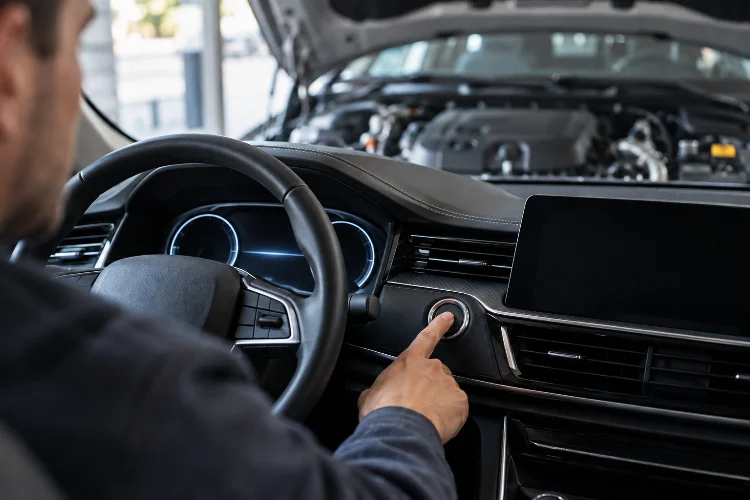
You get into your car, press the brake pedal, turn the key or push the start button, and within a second or two the engine comes to life. It feels almost instant.
Behind that simple action, however, a carefully coordinated sequence of electrical, mechanical, and chemical events is taking place under the hood. The battery sends a large burst of electrical power.
A starter motor begins rotating the engine. Fuel and air enter the cylinders, spark plugs ignite the mixture, pistons begin moving, and the engine control computer constantly adjusts dozens of variables to keep everything running smoothly.
Understanding what happens inside an engine when you start a car is a great introduction to automotive engineering because the starting process connects many of the vehicle’s most important systems.
You do not need to be a mechanic to understand it. Once the sequence is broken into individual stages, starting an engine becomes much easier to visualize.
Step 1: The Battery Wakes Up the Car
Before gasoline can burn or pistons can move, the vehicle needs electricity.
When you turn the ignition key or press the start button, the battery supplies electrical energy to several systems. Modern vehicles may activate the engine control module, fuel system, dashboard electronics, sensors, ignition system, and starter circuit almost immediately.
The U.S. Department of Energy describes the battery as the component that supplies electricity for starting the engine and powering vehicle electronics.
This is why a weak battery is one of the most common reasons a car struggles to start. The lights and radio might still work because they require relatively little electrical power, while the starter motor requires a much larger amount of current.
Cold weather can make the situation more difficult. Low temperatures can reduce battery performance while also making engine oil thicker, meaning the starter has to work harder to rotate the engine.
Step 2: The Starter Motor Begins Cranking the Engine
An internal combustion engine cannot simply begin operating from a complete stop. Something must rotate it first.
That job belongs to the starter motor.
The starter is a powerful electric motor connected temporarily to the engine during startup. When the driver requests a start, a solenoid helps move a small starter gear into contact with the ring gear on the engine’s flywheel or flexplate.
The starter then rotates the crankshaft.
HELLA explains that internal combustion engines require external energy to begin operating because they cannot start themselves. The starter motor provides enough rotational speed for the engine’s normal combustion process to begin.
The rapid sound you hear before an older car actually starts-often described as “cranking”-is largely the starter spinning the engine.
During this stage, pistons are already moving up and down inside the cylinders. The engine is turning, but it is not yet running under its own power.
Step 3: The Fuel and Air Systems Prepare for Combustion
Rotating the engine is only part of the process. The cylinders also need the correct combination of fuel and air.
Modern gasoline vehicles usually rely on electronic fuel injection.
A fuel pump moves gasoline from the tank through fuel lines toward the injection system. Fuel injectors then deliver carefully measured quantities of gasoline either into the intake system or directly into the combustion chambers, depending on the engine design.
At the same time, air enters through the intake system.
The engine control unit uses information from multiple sensors to determine how much fuel should be added.
Depending on the vehicle, these sensors may monitor air flow, intake pressure, crankshaft position, camshaft position, throttle position, coolant temprature, and other conditions.
The objective is simple: provide a combustible air-fuel mixture at exactly the right moment.
Modern engines perform these calculations so quickly that drivers normally never notice them happening.
Step 4: The Computer Determines Where the Pistons Are
The engine cannot simply inject fuel and create sparks randomly.
Timing is critical.
The engine control module needs to know where the crankshaft and camshaft are positioned so that it can determine which cylinder is ready for combustion. Sensors monitor their rotation and send this information to the computer.
Imagine four musicians trying to play a song together. Even if every musician has the correct notes, the music will sound terrible if everyone plays at a different time.
An engine works in a similar way.
Fuel injection, valve operation, piston movement, and ignition must happen in a carefully coordinated sequence. If that timing becomes seriously incorrect, the engine may run poorly or fail to start altogether.
This precise electronic control is one of the major differences between modern engines and older automotive systems that relied more heavily on mechanicaly controlled ignition and fuel delivery.
Step 5: Spark Plugs Ignite the Air-Fuel Mixture
Now the engine is rotating, air is entering, and fuel has been supplied.
The next requirement is ignition.
In a gasoline engine, the ignition system sends high voltage to the spark plugs. A spark jumps across the small gap at the end of each plug, igniting the compressed air-fuel mixture inside the appropriate cylinder.
Combustion creates rapidly expanding gases.
Those gases push the piston downward with significant force. The connecting rod transfers that movement to the crankshaft, helping it continue to rotate.
This is the basic operating principle of a spark-ignition internal combustion engine. The Department of Energy explains that expanding combustion gases push the piston, which then rotates the crankshaft and ultimately provides mechanical power.
Once enough cylinders begin producing successful power strokes, something important happens: the engine no longer needs the starter motor to keep spinning it.
It can run by itself.
Step 6: The Starter Disengages as the Engine Comes to Life
The starter motor is only intended to operate briefly.
Once combustion raises engine speed above normal cranking speed, the starter gear disengages from the flywheel or flexplate. Keeping the starter permanently connected would make it spin far faster than it was designed to operate.
From this point forward, combustion keeps the crankshaft turning.
Each cylinder repeatedly goes through the familiar four-stroke process: intake, compression, power, and exhaust. In most four-stroke engines, the crankshaft completes two revolutions for every full combustion cycle in a cylinder.
These cycles happen incredibly quickly.
For example, an engine idling at 800 RPM has a crankshaft rotating roughly 13 times every second. Increase engine speed to 3,000 RPM, and the crankshaft is rotating 50 times per second.
What felt like one simple push of a button has now become a continuous series of controlled explosions and moving mechanical parts.
Step 7: The Alternator Takes Over Much of the Electrical Work
Starting an engine takes energy out of the battery.
Once the engine is running, that energy needs to be replenished.
This is where the alternator becomes important. The engine mechanically drives the alternator, which generates electricity for vehicle electrical systems while also recharging the battery.
HELLA notes that the alternator supplies electrical consumers while the vehicle is operating and charges the starter battery at the same time.
This creates an interesting transition.
Before startup, the battery is essentially supporting the process. After startup, the running engine allows the alternator to become a major source of electrical power.
A failing alternator may therefore allow a car to start normally at first but eventually cause electrical problems as the battery loses its stored energy.
What Happens During a Cold Start?
A cold start occurs when the engine and its emission-control components have cooled substantially before being started again.
This situation requires special attention from the engine computer.
Fuel does not vaporize as easily when components are cold, friction can be higher, and engine oil may circulate differently until it warms. The computer may temporarily modify fuel delivery, ignition timing, and idle speed to help stabilize combustion.
Cold starts also matter for emissions.
Catalytic converters work most effectively after reaching an appropriate operating temperature.
During the first moments after a cold engine starts, the catalyst may not yet be fully effective at processing exhaust pollutants. EPA research has long identified the cold-start period as an important part of vehicle emissions.
You may also notice a cold engine initially idling faster than it does after warming up.
That behavior is often intentional. The engine management system can temporarily increase idle speed to help maintain stable combustion and warm important components more quickly.
Why Does an Engine Sometimes Struggle to Start?
Because several systems must cooperate, a starting problem does not always mean the engine itself is damaged.
A weak or discharged battery can prevent the starter from turning quickly enough. A failing starter may produce clicking sounds but fail to crank the engine properly.
Fuel problems can create another type of failure. If the fuel pump cannot produce sufficient pressure or the injectors cannot deliver gasoline properly, the engine may crank without starting.
Ignition problems can have a similar effect. Worn spark plugs, damaged ignition coils, faulty sensors, wiring problems, or incorrect timing can prevent reliable combustion.
Listen to what the vehicle does when you attempt to start it. No sound, repeated clicking, slow cranking, normal cranking without ignition, and starting followed immediately by stalling can point toward seperate categories of problems.
Modern diagnostic systems can make troubleshooting much easier, but serious starting problems should still be inspected properly rather than solved by repeatedly cranking the engine.
What About Diesel and Start-Stop Engines?
Not every engine starts in exactly the same way.
Diesel engines use compression ignition rather than spark plugs for normal combustion. Air is compressed strongly enough to become extremely hot, and diesel fuel injected into that hot air ignites. In cold conditions, many diesel engines use glow plugs to assist the starting process.
Vehicles equipped with automatic start-stop systems present another interesting case.
These systems may shut the engine down at traffic lights and restart it when the driver releases the brake or presses the accelerator.
Because this creates far more starting cycles than traditional driving, compatible vehicles typically use starting and charging components designed for the additional workload.
The overall principle, however, remains familiar: rotate the engine, establish combustion, and transition from external starting power to self-sustaining operation.
So, what happens inside an engine when you start a car? In just a few seconds, the battery activates the vehicle’s electrical systems, the starter rotates the crankshaft, fuel and air enter the cylinders, and the ignition system begins combustion.
Once the first successful power strokes occur, the engine becomes self-sustaining. The starter disengages, the alternator begins supporting the electrical system, and the engine computer continually adjusts fuel, ignition timing, and idle operation as conditions change.
It is a surprisingly complex chain of events hidden behind one simple turn of a key or push of a button.
The next time you start your car, listen carefully to those first few seconds. Understanding that short sequence is an excellent foundation for learning more about fuel injection, ignition systems, engine sensors, batteries, and automotive diagnostics.