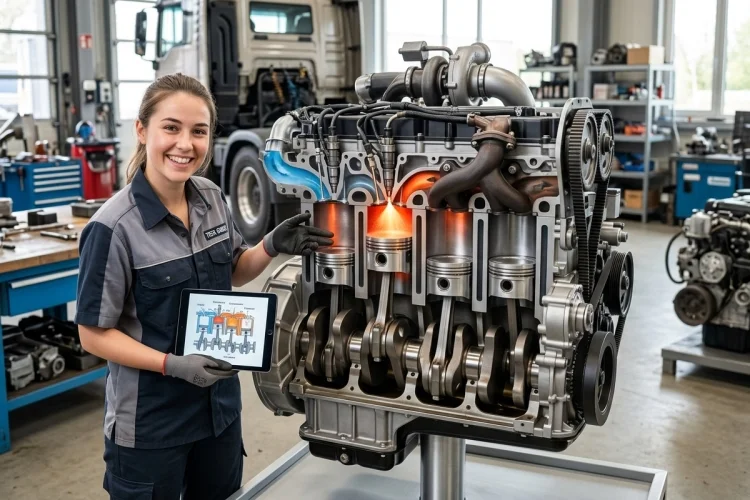
Diesel engines power everything from family cars and delivery vans to buses, tractors, ships, and heavy construction equipment. They are especially popular when strong pulling power, durability, and efficient long-distance driving matter.
But how does a diesel engine work without using spark plugs like a petrol engine? The basic idea is surprisingly simple. A diesel engine draws air into a cylinder, compresses it until it becomes extremely hot, and then injects a fine mist of fuel.
The heat of the compressed air ignites the diesel, creating pressure that pushes a piston downward. That piston is connected to a crankshaft, which converts its up-and-down movement into rotation.
The rotation is then transferred through the transmission and drivetrain to move the vehicle. Most automotive diesel engines use a four-stroke cycle consisting of intake, compression, power, and exhaust.
Modern versions add high-pressure fuel injection, turbocharging, computer controls, and exhaust-treatment systems, but the basic compression-ignition principle remains the same.
What Makes a Diesel Engine Different?
Both petrol and diesel engines are internal combustion engines. They burn fuel inside cylinders to create the pressure needed to move pistons.
The biggest difference is how combustion begins. A petrol engine normally mixes air and fuel and then uses a spark plug to ignite the mixture. A diesel engine compresses air so strongly that its temperature rises enough to ignite fuel when it is injected.
This is why a diesel engine is called a compression-ignition engine. It does not normally need spark plugs to keep running.
Diesel engines also tend to use higher compression ratios than petrol engines. Their blocks, pistons, crankshafts, connecting rods, and cylinder heads must therefore be strong enough to handle greater internal pressure.
This heavy-duty construction contributes to diesel durability, although it can also make the engine heavier and more expensive to manufacture.
The Four-Stroke Diesel Engine Cycle
Most diesel engines complete one operating cycle through four piston strokes. The crankshaft rotates twice during the full sequence.
1. Intake Stroke
The intake valve opens and the piston moves downward. This movement draws fresh air into the cylinder.
Unlike many petrol engines, a conventional diesel does not pull in a prepared air-fuel mixture. It normally takes in air alone during this first stage.
Many modern diesels use a turbocharger to force additional air into the cylinder. The extra oxygen allows the engine to burn more fuel efficiently and produce greater torque.
2. Compression Stroke
The intake valve closes and the piston moves upward. With both valves closed, the air becomes trapped and is squeezed into a much smaller space.
Compressing the air increases both its pressure and temperature. Near the top of the piston’s travel, the air is hot enough to ignite finely atomised diesel fuel.
The compression stage is essential. If an engine cannot create sufficient compression because of worn piston rings, damaged valves, or another internal problem, it may become difficult to start.
3. Power Stroke
Near the end of the compression stroke, an injector sprays diesel directly into the hot air. The fuel begins to burn, causing gas pressure inside the cylinder to rise rapidly.
That pressure pushes the piston downward. A connecting rod transfers the force to the crankshaft, creating the rotational movement that eventually drives the wheels.
Diesel combustion is controlled by the quantity, pressure, pattern, and timing of fuel injection. Modern engines may divide fuel delivery into several small injections rather than releasing the full amount at once.
4. Exhaust Stroke
After the power stroke, the exhaust valve opens and the piston moves upward again. It pushes the burned gases out of the cylinder and into the exhaust system.
Once the gases have left, the exhaust valve closes and the intake stroke begins again. This process repeats thousands of times every minute while the engine is running.
How Diesel Fuel Injection Works
Older diesel engines often used mechanical pumps to control fuel delivery. Modern vehicles generally use electronically managed high-pressure systems.
A common-rail system stores pressurised fuel in a shared pipe called the rail. Individual injectors then deliver accurately measured quantities to each cylinder.
Separating fuel-pressure generation from the injection event gives the engine computer greater freedom to control injection timing and pressure. Bosch identifies this flexibility as a major advantage of common-rail technology.
The injectors do not simply pour fuel into the cylinder. They spray it through extremely small openings, producing a fine mist that mixes more effectively with hot compressed air.
The engine control module adjusts injection according to factors such as engine speed, load, temperature, accelerator position, and boost pressure. Accurate control helps improve performance, fuel economy, starting, noise, and emissions.
Because modern diesel systems operate at very high pressure, repairs should be performed by trained technicians. Fuel escaping from a high-pressure line can cause serious injury and should never be checked by hand.
Why Diesel Engines Use Turbochargers
A turbocharger uses exhaust-gas energy to spin a turbine. This turbine is connected to a compressor that pushes additional air into the intake system.
More air means more oxygen is available for combustion. The engine can therefore burn a larger amount of fuel and produce more power without needing a much larger displacement.
Compressed air becomes hotter, so many turbocharged diesels also use an intercooler. This component cools the air before it enters the engine, increasing its density and helping the engine produce more consistent power.
Turbocharging is one reason a relatively small modern diesel can generate strong low-speed torque. That pulling force makes diesel engines well suited to towing, carrying heavy loads, and driving large commercial vehicles.
However, turbochargers depend on clean engine oil for lubrication and cooling. Delayed oil changes, an incorrect lubricant, or shutting down a heavily worked engine under unsuitable conditions can shorten turbocharger life.
How a Diesel Engine Starts Without Spark Plugs
Compression heat starts combustion once a diesel engine is running, but cold starting can be more difficult. When the engine and outside air are cold, compression may not immediately create enough heat for reliable ignition.
Many diesel engines use glow plugs to solve this problem. A glow plug is an electrical heating element fitted in or near the combustion chamber.
When the ignition is switched on, the plugs heat the incoming air or combustion area. A dashboard symbol may appear briefly while the system prepares the engine for starting.
Glow plugs are not the diesel equivalent of continuously firing petrol spark plugs. They mainly assist during cold starts and, in some vehicles, may remain active briefly afterward to improve combustion and reduce smoke.
A weak battery can also cause diesel starting problems. Diesel engines generally need strong cranking speed to build enough compression temperature, so battery and starter condition are particularly important.
How Modern Diesels Control Exhaust Emissions
Diesel combustion can produce nitrogen oxides and particulate matter, commonly described as soot. Modern vehicles use several systems to reduce these pollutants before they leave the tailpipe.
An exhaust gas recirculation system sends a controlled amount of exhaust back into the intake. This can reduce combustion temperature and help limit nitrogen-oxide formation.
A diesel oxidation catalyst helps process certain exhaust pollutants. A diesel particulate filter, or DPF, captures soot particles and periodically burns much of the collected material during a process called regeneration.
EPA describes DPFs and diesel oxidation catalysts as exhaust after-treatment devices used to reduce diesel emissions.
Many newer diesel vehicles also use selective catalytic reduction. This system injects diesel exhaust fluid, often called DEF or AdBlue, into the exhaust stream to help convert nitrogen oxides into less harmful substances.
According to the Alternative Fuels Data Center, systems may combine a DPF, oxidation catalyst, DEF dosing, and selective catalytic reduction before exhaust exits the tailpipe.
Frequent short trips can make DPF regeneration more difficult because the exhaust may not remain hot enough. Drivers should follow vehicle-specific instructions if a regeneration warning appears.
Why Diesel Engines Produce Strong Torque
Diesel engines are known for producing useful torque at relatively low RPM. Several design characteristics contribute to this behaviour.
High compression, turbocharging, long piston strokes, and controlled fuel injection can create strong cylinder pressure without requiring extremely high engine speed. This makes the vehicle feel powerful when pulling away, climbing hills, or carrying weight.
Torque and horsepower are related but not identical. Torque is twisting force, while horsepower describes how quickly that force can perform work.
A diesel engine may produce impressive low-speed torque but reach its maximum RPM sooner than a petrol engine. This is why diesel vehicles often feel strong in everyday acceleration even when their peak horsepower figure is not unusually high.
The actual result depends on engine displacement, turbocharger design, gear ratios, ECU calibration, and the intended use of the vehicle.
Essential Diesel Engine Maintenance
Diesel engines can be durable, but they still require regular care. Use the correct oil specification and follow the manufacturer’s service schedule, especially because the lubricant also protects the turbocharger.
Replace the fuel filter at the recommended interval. Diesel injection equipment is manufactured to precise tolerances, and contaminated fuel can damage pumps and injectors.
The air filter also matters because restricted airflow can reduce performance and increase smoke. Inspect intake hoses for cracks or loose connections, particularly around turbocharged systems.
Pay attention to DPF and DEF warnings. Ignoring an emissions-system problem can result in reduced engine power or an expensive repair.
Common warning signs include difficult starting, excessive black or white smoke, rough running, knocking, power loss, rising oil level, or unusually frequent DPF regeneration.
Cummins notes that hard starting can be linked to glow plugs, the battery, or the fuel system, although accurate diagnosis is still required.
So, how does a diesel engine work? It pulls air into a cylinder, compresses that air until it becomes hot, injects fuel, and uses the resulting combustion pressure to push a piston. The crankshaft converts that piston movement into rotation that drives the vehicle.
Modern diesel engines combine this basic process with common-rail injection, turbocharging, electronic controls, glow plugs, and sophisticated exhaust-treatment systems.
These technologies improve power, efficiency, starting, and emissions performance. Understanding the basics makes diesel maintenance and warning lights much easier to follow.
Check your owner’s manual, use the correct oil and fuel, replace filters on schedule, and respond promptly to DPF, DEF, temperature, or engine warnings. Proper care is the key to keeping a diesel engine strong, efficient, and dependable.