When you think about what makes a car engine work, pistons, spark plugs, and fuel injectors probably come to mind first.
But hidden inside the engine is another component that plays a huge role in determining when the engine can breathe, produce power, and release exhaust gases: the camshaft.
A camshaft does not create combustion itself. Instead, it controls the valves that allow air into the cylinders and exhaust gases back out. If those valves opened even slightly too early or too late, engine performance could suffer dramatically.
Understanding what is a camshaft and how does it work is therefore one of the best starting points for learning about internal combustion engines.
The basic idea is easier than it sounds. A rotating shaft with specially shaped lobes repeatedly opens the engine’s valves in a precise sequence. That simple mechanical action has a major influence on horsepower, fuel economy, emissions, and overall drivability.
What Is a Camshaft?
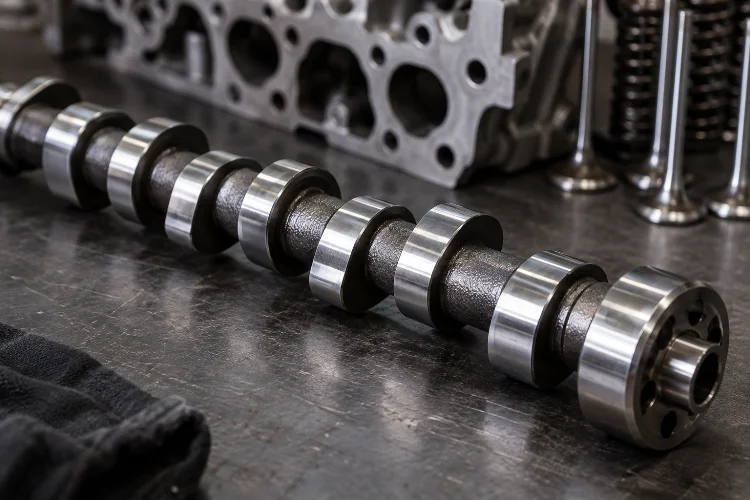
A camshaft is a rotating metal shaft equipped with specially shaped sections known as cam lobes or simply cams.
Its primary job is to control when the intake and exhaust valves open and close. These valves regulate the movement of gases into and out of the engine’s combustion chambers.
During the intake stroke, the intake valve must open so air-or an air-fuel mixture, depending on the fuel system-can enter the cylinder. Later, the exhaust valve opens so burned gases can escape.
Haynes describes the camshaft as the component responsible for operating the valves in the cylinder head. The timing of those valves must remain synchronized with piston movement for the engine to operate properly.
Without a functioning camshaft, a conventional four-stroke piston engine simply could not manage this gas exchange correctly.
How Does a Camshaft Work?
Imagine a straight metal shaft with several egg-shaped bumps positioned along its length.
Those bumps are cam lobes.
As the shaft rotates, the raised portion of each lobe pushes against a valve mechanism. Depending on the engine design, the cam may act directly on a valve lifter or indirectly through components such as rocker arms or pushrods.
As the highest section of the lobe passes, it pushes the valve open. When the lobe rotates away, a valve spring pushes the valve back into its closed position.
This process happens thousands of times while you drive.
The position and shape of each lobe are carefully engineered so every valve opens at the correct point in the four-stroke combustion cycle: intake, compression, power, and exhaust.
In other words, the camshaft acts almost like a mechanical conductor, making sure each valve performs its job at precisely the right moment.
Why Cam Lobes Matter
A cam lobe might look like a simple bump on a metal shaft, but its shape has a major influence on engine behavior.
Three important concepts are timing, lift, and duration.
1. Valve Timing
Valve timing describes when a valve begins opening and when it closes relative to the position of the piston and crankshaft.
Engine designers do not always wait until a piston reaches the exact beginning or end of a stroke before moving a valve. Opening or closing a valve slightly earlier or later can improve airflow and engine performance.
2. Valve Lift
Lift describes how far the valve opens.
More lift can allow a larger amount of air to flow through the cylinder head. However, simply increasing lift does not automatically make an engine better because the entire intake, exhaust, and combustion system must work together.
3. Duration
Duration describes how long a valve remains open, usually measured in degrees of crankshaft rotation.
Performance camshafts may use different lift and duration characteristics to improve airflow at higher engine speeds. The trade-off is that an aggressive camshaft profile can sometimes reduce smoothness or low-speed drivability.
This is why camshaft design is so important when engineers tune an engine for economy, towing, everyday driving, or high-performance use.
How Are the Camshaft and Crankshaft Connected?
The camshaft cannot operate independently of the crankshaft.
The crankshaft converts the pistons’ up-and-down movement into rotational motion. The camshaft uses that rotation to control the valves.
The two components are connected through a timing belt, timing chain, or, in some engines, a gear system.
In a four-stroke engine, the crankshaft completes two full rotations during one complete combustion cycle. The camshaft therefore rotates at half the crankshaft’s speed.
For example, if the crankshaft is spinning at 2,000 revolutions per minute, the camshaft rotates at approximately 1,000 RPM.
Maintaining this relationship is critical.
If the timing belt or chain jumps several teeth, stretches significantly, or fails completely, valve timing may move out of synchronization with piston movement.
In some interference engines, incorrect timing can even allow the pistons to strike open valves, potentially causing expensive internal engine damage. Haynes specifically warns that failure of the timing system can allow piston-to-valve contact in applicable engines.
SOHC vs. DOHC vs. Pushrod Engines
Not every engine places its camshaft in the same location.
Three common configurations are OHV, SOHC, and DOHC.
1. OHV or Pushrod Engines
In an overhead-valve engine, sometimes called a pushrod engine, the camshaft is located inside the engine block.
The camshaft moves lifters and long pushrods, which then operate rocker arms mounted near the cylinder head. The rocker arms finally push the valves open.
This design can be relatively compact, but it requires more moving components between the camshaft and valves.
2. SOHC Engines
SOHC stands for Single Overhead Camshaft.
Here, the camshaft sits in or above the cylinder head. A single camshaft generally controls both the intake and exhaust valves for that cylinder bank.
Placing the cam closer to the valves can reduce the number of intermediate valvetrain components.
3. DOHC Engines
DOHC means Dual Overhead Camshaft.
A typical DOHC cylinder head uses one camshaft to control intake valves and another to operate exhaust valves. This layout gives engineers additional flexibility when designing multi-valve cylinder heads and variable valve timing systems.
DOHC engines are now common in modern passenger vehicles, although the best configuration ultimately depends on the engine’s intended purpose.
What Is Variable Valve Timing?
Traditional engines used camshafts with essentially fixed valve timing.
That creates a compromise because the ideal valve timing for smooth low-speed driving may not be ideal for high-speed power.
Variable Valve Timing, or VVT, helps solve that problem.
Modern VVT systems can change the rotational relationship between a camshaft and its drive gear while the engine is running. This allows the engine computer to advance or retard valve timing depending on RPM, engine load, temperature, and other operating conditions.
One common design uses oil pressure controlled by a solenoid to operate a camshaft phaser. The phaser changes the position of the camshaft relative to its sprocket.
The result can be better fuel economy, stronger performance, reduced emissions, or a combination of these benefits.
Different manufacturers use different names and strategies for variable valve systems. Honda’s VTEC technology, for example, is one well-known approach, although systems can vary substantially in how they control timing, valve lift, or both.
This technology makes modern valve control much more flexable than the purely fixed systems common in older engines.
What Is a Camshaft Position Sensor?
Modern engines also need to know exactly where the camshaft is during rotation.
That job belongs to the camshaft position sensor.
The sensor sends camshaft position information to the engine control computer. Combined with data from the crankshaft position sensor, this information helps the computer identify where individual cylinders are in the combustion cycle.
The data can then be used to control processes such as fuel injection and ignition timing.
A failing camshaft position sensor may cause difficult starting, rough running, poor acceleration, reduced fuel economy, or a check-engine warning.
However, these symptoms can have many possible causes, so proper diagnosis is important before replacing components.
What Happens When Camshaft Timing Goes Wrong?
Camshaft-related problems are not always caused by the shaft itself.
A worn timing chain, damaged tensioner, defective VVT solenoid, low or dirty engine oil, faulty camshaft position sensor, or worn valvetrain component can all interfere with proper operation.
Drivers might notice rough idle, unusual rattling, reduced power, increased fuel use, misfires, or difficulty starting.
Variable valve timing systems are especially dependent on correct oil pressure and clean oil because many designs use pressurized engine oil to control the cam phaser.
This makes regular oil changes more important than simply keeping internal surfaces lubricated. On many modern engines, engine oil also helps operate sophisticated valve-timing hardware.
Timing belts deserve attention as well. If your vehicle uses one, follow the manufacturer’s recommended replacement interval rather than waiting for obvious symptoms.
Preventive maintenence is much cheaper than repairing bent valves or damaged pistons after a major timing-system failure.
Why Does the Camshaft Affect Engine Performance?
An engine is essentially an air pump combined with a combustion system.
To make power efficiently, it must bring fresh air into the cylinders and remove exhaust gases afterward.
The camshaft has enormous influence over that breathing process.
Change when a valve opens, how far it opens, or how long it remains open, and you change the engine’s airflow characteristics.
That is why performance engine builders frequently discuss camshafts when modifying an engine. A different cam profile can shift the engine’s useful power range toward lower or higher RPM.
Manufacturers face a more complicated goal. They need smooth idle quality, useful low-speed torque, strong performance, low emissions, good fuel economy, and long-term reliability from the same engine.
Variable valve timing helps engineers achieve a better compromise between these competing requirments.
A camshaft may look like a fairly simple piece of metal, but it performs one of the most important jobs inside an internal combustion engine.
Its lobes control when the intake and exhaust valves open, how far they move, and how long they remain open.
The camshaft stays synchronized with the crankshaft through a timing belt, chain, or gear system and rotates once for every two crankshaft revolutions in a four-stroke engine.
Modern technologies such as DOHC layouts and variable valve timing have made this system even more sophisticated and efficent.
Understanding the camshaft also makes many other engine concepts easier to learn. If you want to continue exploring automotive mechanics, take a closer look at timing chains, valves, crankshafts, VVT systems, and the four-stroke combustion cycle next.