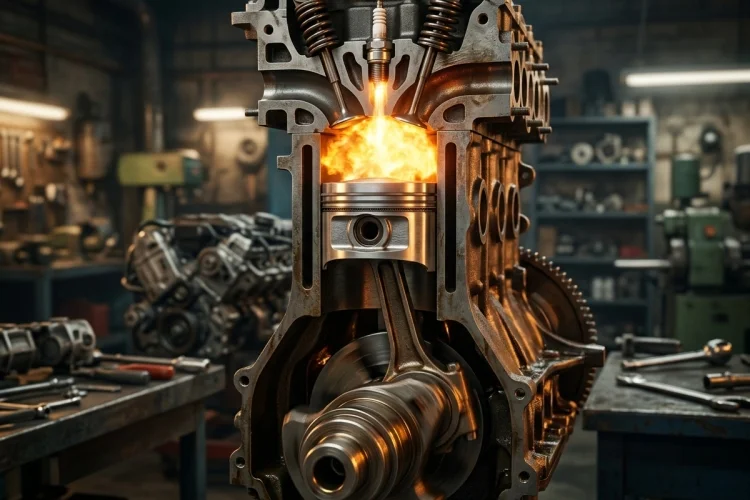
A piston is small enough to hold in your hands, yet it performs one of the most demanding jobs inside a car engine. Every time the engine runs, its pistons move rapidly through extreme heat, pressure, friction, and constantly changing forces.
So, what does a piston do inside an engine? Its main role is to receive pressure from combustion and transfer that force to the crankshaft. In simple terms, the piston helps turn burning fuel into the rotational movement needed to drive the vehicle.
However, the piston does more than move up and down. It also helps draw air into the cylinder, compresses the air or air-fuel mixture, pushes exhaust gases out, and works with piston rings to seal the combustion chamber.
The U.S. Department of Energy explains that expanding combustion gases push a moving piston inside a fixed cylinder. The piston then helps rotate the crankshaft, converting part of the fuel’s chemical energy into useful mechanical work.
What Is an Engine Piston?
A piston is a cylindrical engine component that moves repeatedly inside a cylinder. It is connected to the crankshaft through a piston pin and connecting rod.
The flat or shaped upper surface is called the piston crown. This section faces the combustion chamber and receives the pressure created when fuel burns.
The lower section, known as the piston skirt, helps guide the piston as it moves along the cylinder wall. Grooves near the crown hold piston rings, which help maintain compression and control the amount of oil left on the cylinder surface.
Modern pistons must survive substantial mechanical and thermal loads. Manufacturers therefore design them to balance strength, low weight, heat management, friction reduction, and durability.
Many passenger-car pistons are made from aluminium alloys, although steel pistons are also used in some highly loaded diesel applications.
The Piston’s Role in the Four-Stroke Cycle
Most conventional petrol and diesel car engines operate using a four-stroke cycle. During one complete cycle, the piston travels down, up, down, and up again.
These movements create the intake, compression, power, and exhaust strokes. One full four-stroke cycle requires two complete crankshaft rotations.
1. Intake Stroke
During the intake stroke, the piston moves downward while the intake valve is open. Its movement increases the volume inside the cylinder and helps draw in fresh air.
In many petrol engines, fuel is mixed with the incoming air or injected directly into the cylinder. A diesel engine normally draws in air alone during this stage.
The movement is similar to pulling back the plunger of a syringe. As the available internal space increases, air enters to fill it.
2. Compression Stroke
The intake valve closes, and the piston moves upward. Because both valves are closed, the air or air-fuel mixture becomes trapped and compressed into a much smaller space.
Compression increases the pressure and temperature inside the cylinder. This prepares the charge for efficient combustion.
In a petrol engine, a spark plug ignites the compressed mixture. In a diesel engine, fuel is injected into highly compressed hot air and ignites because of the temperature created by compression.
3. Power Stroke
The power stroke is the stage in which combustion pushes the piston downward. Rapidly expanding gases apply force to the piston crown, sending the piston toward the bottom of the cylinder.
The connecting rod transfers this force to the crankshaft. The crankshaft then changes the piston’s straight up-and-down movement into rotational motion.
This is the stroke that directly produces useful engine power. The crankshaft’s momentum and the power strokes of other cylinders help move each piston through the remaining stages.
4. Exhaust Stroke
After combustion, the cylinder contains burned gases that must be removed. The exhaust valve opens, and the piston moves upward again.
This upward movement pushes the gases out of the cylinder and into the exhaust system. Once the chamber has been cleared, the piston is ready to begin another intake stroke.
How the Piston Turns Combustion Into Rotation
A piston only moves in a straight line, but a car needs rotating force to turn its transmission and wheels. The connecting rod and crankshaft make this conversion possible.
The piston pin, sometimes called a wrist pin or gudgeon pin, connects the piston to the small end of the connecting rod. The other end of the rod attaches to an offset section of the crankshaft.
As the piston moves downward, it pushes the connecting rod at an angle. This turns the crankshaft in much the same way that your leg and a bicycle pedal rotate the bicycle’s crank.
During the power stroke, combustion pressure provides the main pushing force. During the other three strokes, crankshaft rotation moves the piston into the position required for the next combustion event.
NASA describes this process as the conversion of the piston’s linear movement into angular crankshaft motion.
Why Piston Rings Are So Important
A piston does not fit tightly enough against the cylinder wall to create a perfect seal by itself. A small clearance is necessary because the metal expands as the engine warms up.
Piston rings sit inside grooves around the upper section of the piston. These rings provide a flexible seal between the moving piston and the cylinder wall.
1. Compression Rings
The upper rings are primarily responsible for sealing combustion pressure inside the cylinder. Without an effective seal, hot gases could escape past the piston into the crankcase, a problem commonly known as blow-by.
Loss of sealing can reduce cylinder compression and engine power. Escaping combustion gases may also place additional stress on the oil and crankcase ventilation system.
2. Oil-Control Ring
The lower oil-control ring manages the lubricant on the cylinder wall. It leaves a thin protective film while removing excessive oil and directing it back toward the sump.
Too little oil increases friction and wear. Too much oil entering the combustion chamber can increase oil consumption, deposits, smoke, and exhaust emissions.
MAHLE identifies compression rings and oil-control rings as the two main categories within a piston ring pack. The company also notes that modern rings must provide effective sealing while controlling friction, wear, and oil use under increasing temperature and pressure.
How Fast Does a Piston Move?
A piston changes direction at the top and bottom of every stroke. It must accelerate, slow down, stop briefly, and accelerate in the opposite direction thousands of times per minute.
Consider an engine with a 90-millimetre stroke running at 3,000 revolutions per minute. Using the mean piston-speed formula-twice the stroke multiplied by engine speed and divided by 60-the average piston speed is approximately nine metres per second.
At 6,000 rpm, that average increases to around 18 metres per second. Actual instantaneous speed varies throughout the stroke and reaches its highest point between the top and bottom positions.
A four-cylinder four-stroke engine operating at 3,000 rpm produces approximately 6,000 combined power strokes per minute. Each cylinder generates one power stroke for every two crankshaft rotations.
These figures help explain why pistons must be light, strong, accurately manufactured, and properly lubricated. Excessive mass would create greater inertial forces whenever the piston changes direction.
How Heat and Lubrication Affect the Piston
The piston crown is directly exposed to combustion heat, while the skirt continually moves against the lubricated cylinder surface. Temperature control is therefore essential.
Engine oil creates a protective film that reduces direct metal-to-metal contact. It also helps carry heat away from pistons, bearings, cylinder walls, and other moving components.
Some high-performance pistons include internal cooling galleries through which oil can flow. MAHLE notes that piston cooling designs can reduce thermal stress in heavily loaded areas such as the upper piston and ring zone.
The cooling system also indirectly protects the pistons by controlling the temperature of the engine block and cylinder head. If the engine overheats or loses lubrication, the piston can expand excessively and begin rubbing heavily against the cylinder.
In severe cases, the piston may seize, crack, melt, or damage the cylinder wall. Motorservice identifies lubrication failure, abnormal combustion, dirt contamination, incorrect clearances, and overheating among the conditions associated with piston and ring damage.
Common Signs of Piston or Piston-Ring Problems
Pistons are hidden deep inside the engine, so drivers cannot inspect them during routine checks. However, damaged pistons or worn rings may produce noticeable symptoms.
Possible warning signs include reduced engine power, excessive oil consumption, blue exhaust smoke, unusual knocking sounds, low cylinder compression, and increased gases coming from the crankcase.
These symptoms do not automatically prove that a piston has failed. Valve seals, fuel injectors, turbochargers, ignition components, bearings, and other systems can create similar problems.
A compression test or cylinder leak-down test can help a technician locate an internal sealing problem. Further diagnosis may involve inspecting spark plugs, checking crankcase pressure, examining the cylinders with a camera, or disassembling the engine.
Worn or damaged piston rings can lose their ability to seal against the cylinder wall. Motorservice notes that ring wear and sealing problems may lead to power loss, blow-by, and increased oil consumption.
How to Help Protect Your Engine’s Pistons
The best way to protect pistons is to maintain the systems that control lubrication, cooling, airflow, fuelling, and combustion.
Use the engine-oil specification recommended by the vehicle manufacturer and change it at the correct interval. Delaying oil changes can allow contamination and degraded lubricant to increase friction and deposit formation.
Keep the cooling system in good condition and never ignore repeated overheating. A clogged air filter, faulty injector, incorrect ignition timing, cooling failure, or lubrication problem can eventually place abnormal stress on the piston assembly.
It is also wise to avoid demanding maximum power immediately after a cold start. Allowing the engine to warm progressively gives the oil time to circulate and lets its components move closer to their intended operating clearances.
Always investigate warning lights, knocking noises, heavy smoke, rapid oil loss, and unexplained performance changes. Early diagnosis may prevent a manageable fault from becoming serious cylinder or piston damage.
So, what does a piston do inside an engine? It moves through the four-stroke cycle, helps draw in air, compresses the cylinder charge, receives pressure from combustion, and pushes burned gases toward the exhaust.
Its most important job is transferring combustion force through the connecting rod to the crankshaft. Piston rings maintain compression and control oil, while lubrication and cooling protect the assembly from heat and friction.
Although pistons are hidden from view, their condition directly affects power, efficiency, oil consumption, and engine reliability.
Follow the maintenance schedule in your owner’s manual, use the correct oil, monitor the cooling system, and investigate unusual symptoms early. Looking after these supporting systems is one of the most practical ways to help your pistons-and the entire engine-last longer.