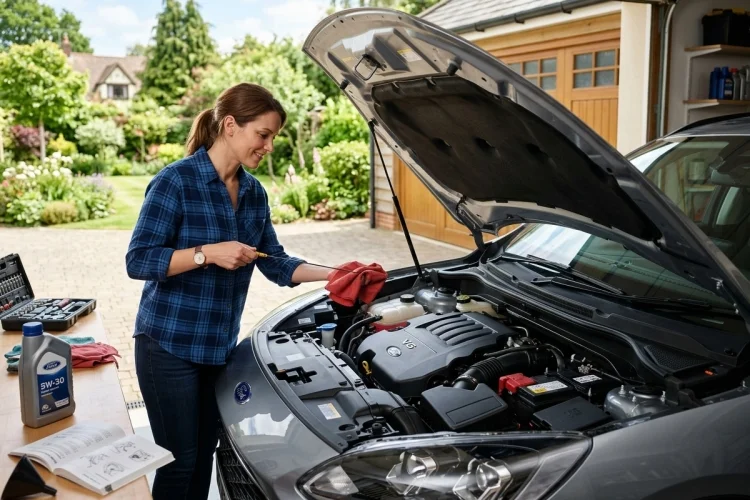
A car engine can run for many years, but it cannot look after itself. Under the bonnet, metal components move at high speed while dealing with heat, pressure, friction, and combustion.
Without regular care, small issues such as low oil, a clogged filter, or a leaking hose can turn into expensive repairs. The good news is that essential engine maintenance does not require advanced mechanical knowledge.
Most car owners simply need to understand which items require attention, when to inspect them, and which warning signs should never be ignored.
Maintenance schedules vary between vehicles, so there is no universal oil-change interval or spark plug replacement date. Your owner’s manual should always be the main source of information for the correct fluids, parts, and service schedule.
Ford, for example, advises owners to follow their vehicle-specific scheduled maintenance guidance rather than relying on one fixed oil interval. Here are the engine maintenance basics every driver should know.
Follow Your Car’s Maintenance Schedule
The owner’s manual is one of the most useful tools that comes with your car. It explains when important components should be inspected, serviced, or replaced.
The schedule may be divided into time and mileage intervals. This matters because some items deteriorate even when the vehicle is not driven very far. Engine oil, rubber hoses, belts, seals, and coolant can all age over time.
Your driving conditions may also affect service requirements. Frequent short journeys, heavy traffic, towing, dusty roads, extreme temperatures, and long periods of idling can place additional stress on the engine.
Avoid assuming that every vehicle needs the same treatment. A modern turbocharged petrol engine may have different oil requirements from an older naturally aspirated model, while a diesel engine may require extra attention to its fuel and emissions systems.
Keeping basic service records is also helpful. Record the date, mileage, type of oil, filters, and parts replaced during each visit. This makes it easier to track upcoming work and can support the vehicle’s resale value.
Check and Change the Engine Oil
Engine oil is often described as the lifeblood of an engine. It circulates around moving components, reduces friction, carries away heat, helps control deposits, and protects internal surfaces.
Over time, the lubricant becomes contaminated and its protective qualities decline. That is why both the oil and oil filter need periodic replacement.
How to Check the Oil Level
Park the vehicle on level ground and follow the procedure in the owner’s manual. Many cars should be checked with the engine switched off after allowing the oil to settle, although the recommended method can differ between models.
Remove the dipstick, wipe it clean, reinsert it fully, and then remove it again. The level should normally sit between the minimum and maximum marks.
Some newer vehicles use an electronic oil-level display instead of a traditional dipstick. Follow the dashboard instructions rather than guessing.
If the level is low, add only the recommended oil type and avoid overfilling. Using the manufacturer-recommended grade can also support fuel efficiency; the U.S. Department of Energy states that the correct motor oil may improve fuel economy by around 1%-2%.
A red oil-pressure warning light requires immediate attention. It may indicate that the engine is not receiving adequate lubrication, and continuing to drive could cause severe damage.
Keep the Cooling System Healthy
Combustion produces intense heat. The cooling system controls that temperature by circulating coolant through the engine and radiator.
Without enough coolant, the engine may overheat. Excessive heat can damage seals, warp metal components, reduce oil performance, and potentially cause head-gasket failure.
Check the coolant reservoir periodically when the engine is completely cold. The level should normally remain between the marked minimum and maximum lines.
Never open a pressurised radiator cap while the engine is hot. Hot coolant and steam can escape suddenly and cause serious burns.
Coolant is not simply coloured water. Different vehicles require different chemical formulations, and incompatible products should not be mixed unless the manufacturer specifically allows it.
Ford advises owners to consult the maintenance section of their manual for the correct coolant specification and checking procedure.
Inspect the ground beneath the car for coloured liquid and look around the engine bay for wet hoses or dried coolant residue. Repeated coolant loss usually indicates a leak that needs professional diagnosis.
Replace Air and Oil Filters on Time
An engine needs clean air to burn fuel properly. The engine air filter traps dust, insects, sand, and other contaminants before they enter the intake system.
As the filter becomes clogged, airflow may be restricted. Depending on the vehicle, this can contribute to reduced performance, poor throttle response, or increased fuel consumption.
Inspection frequency depends heavily on driving conditions. A car regularly used on dusty roads may need its filter checked more often than one driven mainly on clean motorways.
The oil filter has a different job. It removes contaminants and particles from the lubricant before the oil returns to sensitive components such as bearings and camshafts.
Replacing the filter during an oil change helps keep clean oil circulating through the engine. Installing fresh oil while leaving an excessively dirty filter in place can reduce the benefit of the service.
The EPA lists the air cleaner, coolant level, ignition system, fuel system, and diagnostic trouble codes among the areas that may be inspected when a vehicle develops unexpectedly poor fuel economy.
Inspect Belts, Hoses, and Possible Leaks
Belts and hoses may not look complicated, but failure can leave a vehicle stranded or cause serious engine damage.
A serpentine or auxiliary belt may drive components such as the alternator, air-conditioning compressor, and water pump. Look for cracking, frayed edges, missing sections, glazing, or unusual squealing sounds.
The timing belt is even more critical on engines that use one. It keeps the crankshaft and camshaft synchronised so that the pistons and valves move in the correct sequence.
Timing belt replacement intervals vary considerably. Some engines use timing chains instead, but chains and their tensioning systems can still develop problems. Always follow the vehicle-specific schedule rather than waiting for obvious symptoms.
Cooling-system hoses should feel firm but flexible when cold. Bulges, cracks, soft areas, hardened rubber, or leaking connections suggest that replacement may be necessary.
NHTSA notes that heat can degrade rubber belts and hoses and recommends checking oil and coolant as part of seasonal vehicle preparation.
Do not ignore small leaks. A few drops of oil or coolant may seem harmless, but the fluid level can fall gradually while the underlying fault becomes worse.
Maintain Spark Plugs and the Ignition System
Petrol engines use spark plugs to ignite the compressed air-fuel mixture. A healthy plug creates a strong spark at precisely the right moment.
Worn or contaminated spark plugs may contribute to hard starting, rough idling, hesitation, misfires, reduced power, or higher fuel consumption. A flashing check-engine light can indicate an active misfire and should be investigated promptly.
Replacement intervals depend on the plug material and engine design. Some plugs last far longer than others, so avoid using a generic mileage figure.
The correct spark plug type and gap are also important. Ford recommends checking the vehicle-specific maintenance schedule and correct plug-gap information when replacing them.
Diesel engines do not normally use spark plugs for combustion. Many have glow plugs that assist with cold starting, while their injectors and high-pressure fuel systems require specialised servicing.
Ignition coils, wiring, and engine sensors also affect combustion. Replacing parts randomly can be expensive, so fault codes and proper testing should guide repairs.
Pay Attention to Dashboard Warning Lights
Modern vehicles constantly monitor engine operation through sensors and an onboard computer. Warning lights provide an early opportunity to address a problem before it becomes more serious.
The check-engine light can appear for many reasons, including sensor faults, ignition misfires, fuel-system problems, air leaks, or emissions-related failures.
A steady light usually means the vehicle needs diagnosis soon, while a flashing light may indicate a more urgent problem.
Temperature and oil-pressure warnings deserve immediate attention. If either appears while driving, stop safely and switch off the engine when appropriate.
Do not simply clear a warning code and assume the fault has disappeared. The code points toward the system where the computer detected a problem, but further diagnosis may still be necessary.
The Department of Energy highlights engine fault codes, oil-life information, coolant temperature, and battery voltage as useful data for proactive vehicle maintenance.
Sudden changes in fuel economy can also act as an informal warning. Unless your route or driving style has changed, an unexplained drop may indicate that the engine requires inspection.
Listen, Look, and Smell for Trouble
Your senses can reveal problems that have not yet triggered a warning light. Get familiar with how your car normally sounds, smells, and behaves.
A new tapping, knocking, rattling, grinding, or squealing noise should not be ignored. Some sounds are minor, but others may point to low oil pressure, belt problems, worn bearings, abnormal combustion, or loose components.
Watch the exhaust as well. A small amount of water vapour during a cold start can be normal, but persistent blue, thick white, or heavy black smoke may indicate an engine or fuel-system problem.
Burning-oil smells, sweet coolant odours, fuel smells, or visible steam all deserve attention. Stop driving when overheating, major fluid loss, heavy smoke, or severe engine noise makes continued operation unsafe.
Regular visual checks take only a few minutes. Look for loose caps, damaged wiring, cracked hoses, leaking fluids, and anything that appears different from the previous inspection.
Avoid Driving Habits That Increase Engine Wear
Maintenance is not limited to replacing parts. The way you drive can also influence engine stress and fuel consumption.
Avoid heavy acceleration immediately after a cold start. The engine does not need to sit idling for a long time in most situations, but driving gently at first allows the oil and components to reach normal operating conditions progressively.
Repeatedly using full throttle at very low engine speed can place unnecessary load on some engines. Use an appropriate gear and allow the transmission to downshift when more power is required.
Long periods of unnecessary idling waste fuel and may contribute to deposit formation in certain operating conditions. Smooth acceleration and steady speeds generally place less stress on the powertrain than aggressive driving.
Proper maintenance can also reduce running costs. NHTSA advises regular oil changes, fluid checks, battery inspections, and preventive servicing as practical ways to reduce the risk of breakdowns.
Essential engine maintenance comes down to consistency. Check the oil and coolant, replace filters at the correct time, inspect belts and hoses, maintain the ignition system, and follow the schedule provided by your vehicle’s manufacturer.
Just as importantly, pay attention to warning lights, leaks, unusual noises, smoke, and changes in performance.
These early clues can help you address a minor issue before it becomes an expensive engine repair. Set a monthly reminder for basic fluid and visual checks, and keep a simple record of every service.
When something feels wrong, arrange a proper inspection instead of waiting for the problem to disappear. A few minutes of preventive care can make your car safer, more reliable, and less costly to own.