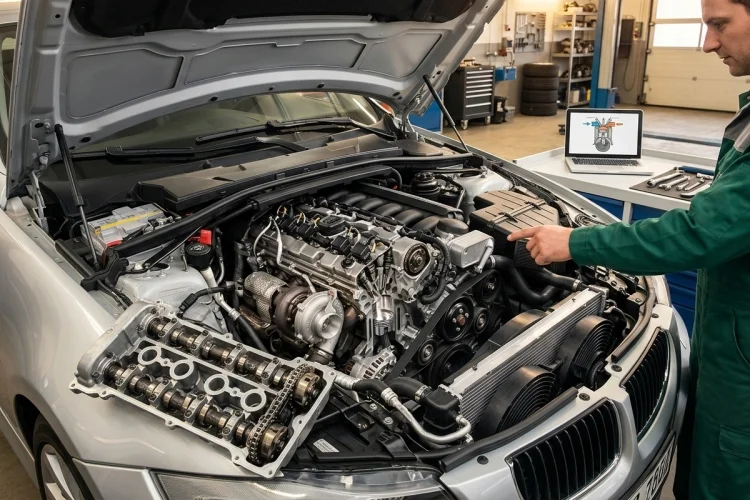
Open a car bonnet, and the engine can look like a tightly packed puzzle of metal, wires, belts, hoses, and plastic covers. However, underneath all that complexity, every component has a specific job.
Some parts create power, others control airflow and fuel, while several systems prevent the engine from overheating or wearing itself out. Understanding the main parts of a car engine and their functions can make vehicle maintenance much less confusing.
You do not need to become a mechanic to benefit from this knowledge. Simply knowing what pistons, valves, spark plugs, and the crankshaft do can help you understand warning lights, unusual noises, and common repair terms.
Most petrol and diesel cars use an internal combustion engine. Fuel burns inside sealed cylinders, creating pressure that moves pistons. That movement is converted into rotation and eventually sent to the wheels.
Let us examine the key engine components and see how they work together.
1. The Engine Block and Cylinder Head
The engine block is the main structural body of the engine. It supports many of the internal moving parts and usually contains the cylinders in which the pistons travel.
Engine Block
The block is commonly made from cast iron or aluminium alloy. Aluminium is lighter and transfers heat effectively, while cast iron is valued for strength and durability.
Inside the block are passages that carry engine oil and coolant. Oil reduces friction between moving surfaces, while coolant absorbs excess heat and transports it toward the radiator.
The number and arrangement of cylinders depend on the engine design. A four-cylinder engine may place all cylinders in a straight line, while a V6 divides six cylinders into two angled banks.
Cylinder Head
The cylinder head sits on top of the engine block and closes the upper part of the cylinders. A head gasket creates a seal between the head and block, helping prevent compression, oil, and coolant from escaping or mixing.
The cylinder head commonly houses the intake and exhaust valves. In petrol engines, it also contains the spark plugs. Many modern engines position fuel injectors and one or more camshafts in this area.
A damaged head gasket can cause overheating, coolant loss, white exhaust smoke, or oil contamination. It is a relatively thin component, but its sealing function is critical.
2. Pistons, Piston Rings, and Connecting Rods
Pistons are cylindrical components that move up and down inside the engine cylinders. They are directly exposed to the pressure and heat created by combustion.
During the power stroke, expanding gases push a piston downward. The piston transfers this force through a connecting rod to the crankshaft, beginning the process of converting fuel energy into useful rotation.
Piston Rings
Small metal rings fit into grooves around each piston. These piston rings help seal the combustion chamber so that pressure does not escape past the piston.
They also control the thin layer of oil on the cylinder walls. When rings become worn, an engine may lose compression, consume excessive oil, produce blue exhaust smoke, or feel noticeably weaker.
Connecting Rods
The connecting rod joins the piston to the crankshaft. Its upper end follows the piston’s straight movement, while its lower end travels in a circular path around the crankshaft.
Connecting rods must withstand repeated changes in direction and intense combustion forces. A serious lubrication problem or abnormal combustion can damage a rod and lead to major engine failure.
3. The Crankshaft, Bearings, and Flywheel
The crankshaft is one of the most important moving parts in an engine. Its job is to convert the pistons’ up-and-down movement into rotational motion.
Offset sections called crankpins allow the connecting rods to turn the shaft as the pistons move.
That rotation is transferred toward the transmission and drivetrain, which eventually deliver power to the wheels. Toyota describes the crankshaft as a core component that converts piston movement into rotating power.
Crankshaft Bearings
The crankshaft rotates on specially designed bearings inside the engine block. Pressurised engine oil forms a protective film between these surfaces, limiting direct metal-to-metal contact.
If the oil supply becomes insufficient, the bearings can overheat and wear rapidly. A deep knocking noise from the lower engine may indicate bearing damage, although proper diagnosis should always be carried out by a qualified technician.
Flywheel or Flexplate
A flywheel is attached to the rear of the crankshaft in many manual-transmission vehicles. Automatic vehicles normally use a thinner component called a flexplate.
This rotating mass helps smooth the separate power pulses produced by the cylinders. It also provides the connection between the engine and transmission. The starter motor engages with teeth around its outer edge when the engine is started.
4. Camshaft, Valves, and the Timing System
An engine must let fresh air enter the cylinders and allow burned gases to leave. The valves, camshaft, and timing system control this process.
Intake and Exhaust Valves
Intake valves open to let air-or an air-fuel mixture-enter the cylinder. Exhaust valves open after combustion so the piston can push waste gases into the exhaust system.
Springs close the valves when they are no longer being pushed open. The timing of this movement affects power, fuel efficiency, emissions, and engine smoothness.
Camshaft
The camshaft contains raised sections called lobes. As the shaft rotates, these lobes operate the valves directly or through components such as lifters, followers, and rocker arms.
Some engines use one camshaft, while others have two or more. A dual overhead camshaft design often uses one shaft for the intake valves and another for the exhaust valves.
Timing Belt or Timing Chain
A timing belt, chain, or gear system keeps the camshaft synchronised with the crankshaft. In a typical four-stroke engine, the crankshaft turns twice for every single camshaft revolution.
This relationship ensures that each valve opens at the correct point in the piston cycle. If a timing belt breaks in certain engine designs, the pistons may strike open valves, causing expensive internal damage.
5. Air, Fuel, and Ignition Components
An internal combustion engine needs a controlled supply of air and fuel. A petrol engine also needs a correctly timed spark.
Air Intake and Throttle Body
Air enters through an air filter, which traps dust and other contaminants. It then passes through intake pipes and, in petrol engines, usually through a throttle body.
The throttle valve changes how much air enters the engine. When the driver presses the accelerator, the engine control system normally opens the throttle further and adjusts fuel delivery to produce more power.
Some vehicles use a turbocharger to force additional air into the cylinders. More air allows the engine to burn more fuel and produce greater output without necessarily increasing engine displacement.
Fuel Injectors
Fuel injectors deliver precisely measured quantities of petrol or diesel. Depending on the design, petrol may be sprayed into the intake port or directly into the combustion chamber.
Modern injectors are electronically controlled and can operate several times during a single engine cycle. Bosch describes the injector as a central part of an internal combustion engine’s fuel-injection system.
Spark Plugs
Petrol engines use spark plugs to ignite the compressed air-fuel mixture. Each plug creates an electrical spark inside its cylinder at a carefully controlled moment.
Diesel engines work differently. They compress air until its temperature rises significantly, then inject fuel into the hot air. The fuel ignites through compression rather than a conventional spark.
6. Lubrication and Cooling System Parts
An engine creates substantial heat and friction. Without lubrication and cooling, its internal parts could fail within a short time.
Oil Pump, Filter, and Sump
Engine oil is stored in a lower reservoir commonly called the sump or oil pan. The oil pump draws lubricant from this reservoir and circulates it through passages leading to bearings, camshafts, pistons, and other components.
The oil filter removes dirt, metal particles, and combustion by-products. Clean oil reduces wear, helps control heat, and protects internal surfaces from corrosion.
Low oil pressure is different from simply having old oil. When an oil-pressure warning appears, the engine may not be receiving adequate lubrication, so continuing to drive could cause serious damage.
Water Pump, Thermostat, and Radiator
Coolant moves through passages in the block and cylinder head, absorbing heat. The water pump circulates this liquid between the engine and radiator.
The thermostat controls when coolant flows fully through the radiator. This allows the engine to warm up efficiently and then remain within a safe operating-temperature range.
At the radiator, airflow removes heat from the coolant before it returns to the engine. Cooling fans provide extra airflow when the vehicle is stationary or moving slowly.
Electronic Controls and Supporting Components
Modern engines depend on electronics as much as mechanical hardware. The engine control unit, or ECU, acts like a central computer.
It receives information from sensors measuring airflow, oxygen levels, engine temperature, throttle position, crankshaft speed, and other conditions. It then adjusts fuel injection, spark timing, emissions systems, and sometimes valve timing.
Bosch describes the electronic engine control unit as the central controller of the engine-management system.
The starter motor turns the crankshaft when the driver starts the vehicle. After the engine begins running, the alternator generates electrical power and helps recharge the battery.
Sensors may not produce mechanical power, but inaccurate readings can cause rough idling, poor acceleration, increased fuel consumption, or warning lights. This is why modern fault diagnosis often begins by reading stored ECU trouble codes.
How All the Engine Parts Work Together
In a four-stroke engine, the piston completes intake, compression, power, and exhaust strokes. The crankshaft completes two rotations during one full cycle, while the camshaft operates the valves in synchronisation.
For example, each cylinder in a four-stroke engine running at 3,000 revolutions per minute produces approximately 1,500 power strokes per minute. A four-cylinder engine therefore generates about 6,000 individual power strokes each minute.
The process only works when all components remain coordinated. Pistons create movement, connecting rods transfer force, the crankshaft produces rotation, valves manage airflow, and injectors deliver fuel.
Meanwhile, oil limits friction, coolant controls temperature, and the ECU continually adjusts the system. A failure in one area can quickly affect several others, which is why unusual sounds, leaks, warning lights, and overheating should not be ignored.
The main parts of a car engine perform different jobs, but they depend heavily on one another. The engine block and cylinder head provide the structure, while pistons, connecting rods, and the crankshaft convert combustion pressure into rotation.
Valves and camshafts control airflow, injectors deliver fuel, and spark plugs ignite the mixture in petrol engines. At the same time, the lubrication and cooling systems protect these components from friction and excessive heat.
Learning these basic functions makes repair terminology and routine maintenance easier to understand. Check your vehicle’s oil and coolant regularly, follow its recommended service schedule, and pay attention to warning lights.
The more familiar you become with the engine under your bonnet, the easier it will be to recognise potential problems before they turn into major repairs.