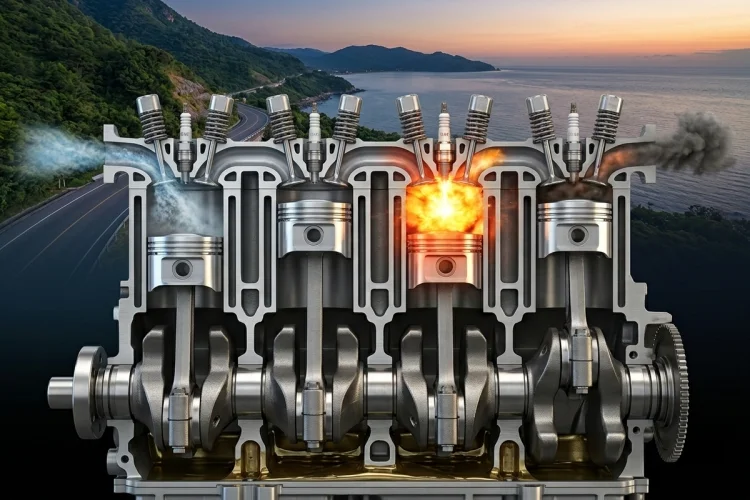
A car engine can look incredibly complicated when you open the bonnet. There are valves, pistons, belts, wires, sensors, and many other components packed into a relatively small space.
However, the basic process happening inside most petrol and diesel engines is easier to understand than you might expect. At the centre of this process is the four-stroke engine cycle.
It describes four piston movements-intake, compression, power, and exhaust-that allow an internal combustion engine to turn fuel into useful mechanical energy. These strokes repeat thousands of times while a vehicle is moving.
Each complete cycle requires four piston strokes and two full rotations of the crankshaft. The expanding gases created during combustion push the piston, while the crankshaft converts that up-and-down movement into rotation.
That rotation eventually reaches the vehicle’s wheels through the transmission and drivetrain. Let us break down the entire process without complicated engineering language.
What Is a Four-Stroke Engine?
A four-stroke engine is an internal combustion engine that completes one operating cycle in four separate movements of the piston. A stroke happens whenever the piston travels from one end of the cylinder to the other.
The piston moves between two main positions. Top dead centre, often shortened to TDC, is the highest point it reaches. Bottom dead centre, or BDC, is its lowest position.
During a complete four-stroke cycle, the piston travels down, up, down, and up again. At the same time, the crankshaft completes two full revolutions, while the camshaft normally completes one revolution to control the valves at the correct moments.
The four stages are:
- Intake
- Compression
- Power
- Exhaust
Only the power stroke directly produces useful force. The other three prepare the cylinder for combustion or clear it afterward.
Stroke One: The Intake Stroke
The process begins with the intake stroke. The intake valve opens while the piston moves downward from top dead centre toward bottom dead centre.
As the piston descends, it increases the available space inside the cylinder. This creates a pressure difference that helps draw fresh air into the combustion chamber.
In many petrol engines, fuel is mixed with the incoming air either before it enters the cylinder or through direct injection inside the chamber.
The exhaust valve remains closed during this stage because the engine needs to keep the fresh charge inside the cylinder. Once the piston reaches the bottom of its travel, the intake valve closes.
A useful way to picture this stroke is to imagine pulling back the plunger of a syringe. As the internal space becomes larger, air is pulled inside. The piston creates a similar pumping action.
What Happens in a Diesel Engine?
A diesel engine operates slightly differently. During its intake stroke, it normally draws only air into the cylinder rather than a prepared air-fuel mixture.
The fuel is injected later, when the air has already been heavily compressed and heated. This difference is important because diesel engines use compression heat rather than a spark plug to start combustion.
Stroke Two: The Compression Stroke
After the intake valve closes, the piston begins moving upward. Both the intake and exhaust valves remain closed, trapping the fresh charge inside the cylinder.
As the piston rises, it squeezes the contents of the cylinder into a much smaller area. Compression raises the pressure and temperature of the trapped gas, helping the fuel burn more effectively when ignition occurs.
The amount of compression is often described by the engine’s compression ratio. For example, a ratio of 10:1 means the volume above the piston is approximately ten times larger when the piston is at the bottom than when it is at the top.
Higher compression can help an engine extract more useful energy from fuel, but the design must control temperature, pressure, ignition timing, and fuel quality carefully.
Excessive or uncontrolled combustion in a petrol engine may produce knocking, which can reduce performance and potentially damage internal components.
Near the end of the compression stroke, the engine is ready for combustion.
Stroke Three: The Power Stroke
The power stroke is where the engine produces the force that ultimately moves the vehicle.
In a petrol engine, the spark plug fires near the end of the compression stroke. The spark ignites the compressed air-fuel mixture, causing a rapid release of heat and a sharp increase in cylinder pressure.
The expanding gases push the piston downward toward bottom dead centre. The connecting rod transfers this movement to the crankshaft, which converts the piston’s linear motion into rotation.
In a diesel engine, fuel is injected into the hot compressed air. The temperature created by compression causes the fuel to ignite without a conventional spark plug. The resulting pressure then drives the piston downward in much the same way.
It is worth noting that combustion is not simply a dramatic explosion happening randomly inside the cylinder. It is a carefully timed burning process controlled by the engine’s ignition, injection, valve-timing, and electronic management systems.
Stroke Four: The Exhaust Stroke
After the power stroke, the cylinder contains gases left behind by combustion. These waste gases must be removed before the engine can begin another cycle.
The exhaust valve opens, and the piston moves upward from bottom dead centre. Its upward movement pushes the spent gases out of the cylinder and into the exhaust system.
The gases then travel through components such as the exhaust manifold, catalytic converter, silencer, and tailpipe. The main purpose of the exhaust stroke itself is to clear the combustion chamber so that a fresh charge can enter during the next intake stroke.
As the piston approaches the top again, the exhaust valve closes and the intake valve begins opening. The entire sequence then repeats.
In real engines, valve opening and closing do not always happen exactly at the top or bottom of a piston’s movement. Engineers use carefully calculated valve timing-and sometimes brief valve overlap-to improve airflow, efficiency, and performance.
How the Crankshaft and Camshaft Keep Everything Moving
The piston cannot complete the four strokes by itself. It is attached to a connecting rod, which is connected to the crankshaft.
When combustion pushes the piston downward, the crankshaft rotates. Its momentum, supported by the flywheel and power strokes from other cylinders, helps move the piston through the intake, compression, and exhaust stages.
The camshaft controls the opening and closing of the intake and exhaust valves. In a typical four-stroke design, the crankshaft turns twice for every single camshaft revolution. This 2:1 relationship keeps valve operation synchronised with piston movement.
A timing belt, timing chain, or set of gears connects the two shafts. If their timing becomes seriously misaligned, the valves and pistons may no longer move in the correct sequence. In some engine designs, this can lead to major internal damage.
How Often Does the Cycle Happen?
The four stages may sound slow when explained individually, but they happen remarkably quickly in a running engine.
Suppose a single-cylinder four-stroke engine is operating at 3,000 revolutions per minute. Because one complete cycle requires two crankshaft revolutions, that cylinder completes 1,500 cycles-and therefore 1,500 power strokes-every minute.
A four-cylinder engine running at the same speed produces approximately 6,000 combined power strokes per minute. The cylinders fire at different times, creating a smoother and more continuous flow of torque than a single cylinder could provide.
This also explains why correct firing order matters. The engine management and mechanical timing systems coordinate the cylinders so that their power strokes occur in a balanced sequence.
When you press the accelerator, the engine generally takes in more air and adds the appropriate amount of fuel. Stronger or more frequent combustion events then allow it to produce additional torque and power.
Four-Stroke Petrol vs Diesel Engines
Petrol and diesel engines both commonly use the four-stroke cycle, but their combustion methods are different.
A petrol engine usually brings air and fuel together before ignition and uses a spark plug to start combustion. It is therefore known as a spark-ignition engine.
A diesel engine takes in air, compresses it more heavily, and injects fuel into the hot compressed air. The fuel ignites because of the temperature produced by compression, making it a compression-ignition engine.
Despite this difference, both engines still follow the same general sequence: fill the cylinder, compress its contents, produce force through combustion, and remove the waste gases.
Modern versions may also use turbochargers, direct fuel injection, variable valve timing, and electronic controls. These systems make the process more precise, but the basic four-stroke principle remains recognisable.
Why the Four-Stroke Cycle Is So Widely Used
Four-stroke engines are popular because they offer a practical balance of power, fuel control, durability, and emissions management. The separate intake and exhaust strokes allow gases to enter and leave through dedicated valves.
Unlike a basic two-stroke design, a four-stroke engine does not need to complete every stage during a single crankshaft revolution. The more separated process provides engineers with greater control over airflow, compression, combustion, and exhaust removal.
However, a four-stroke engine is not perfectly efficient. Some energy becomes useful crankshaft rotation, while the rest is lost through exhaust heat, cooling, friction, pumping work, noise, and other processes.
The engine therefore depends on several supporting systems. Lubrication reduces friction, cooling controls temperature, fuel injection delivers the correct amount of fuel, and the electrical system provides ignition and electronic control.
The four-stroke engine cycle is easier to remember when you think of four simple actions: intake brings a fresh charge into the cylinder, compression squeezes it, the power stroke turns combustion into movement, and exhaust removes the waste gases.
These four piston movements require two crankshaft revolutions. Although only one stroke directly creates power, every stage is essential for smooth and reliable engine operation.
Understanding this cycle gives you a strong foundation for learning about fuel injection, valve timing, compression ratios, turbocharging, and engine maintenance.
Next time you start a petrol or diesel vehicle, picture its pistons repeating this carefully timed sequence thousands of times. Continue exploring the main engine components, and the machinery under the bonnet will quickly become much less mysterious.