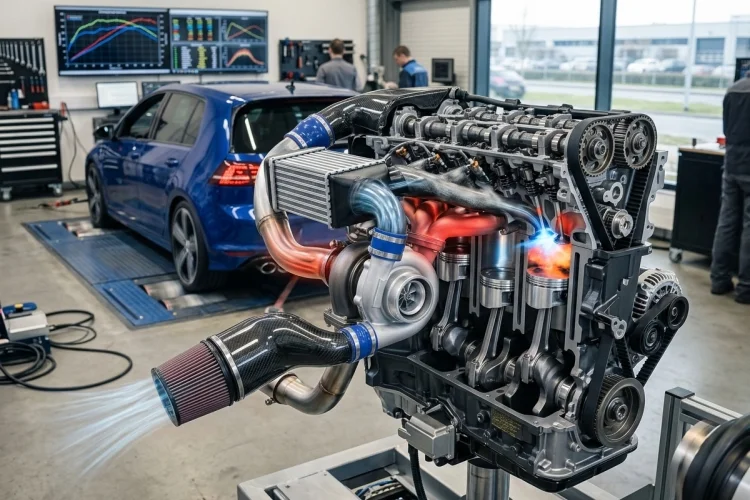
Two engines can have the same displacement yet produce very different amounts of horsepower. A naturally aspirated 2.0-litre family car might feel calm and economical, while another 2.0-litre engine with a turbocharger can deliver sports-car performance.
Clearly, engine size is not the whole story. So, what factors determine an engine’s horsepower? Horsepower depends on how much torque an engine produces and how quickly it can produce that torque.
Airflow, fuel delivery, compression, engine speed, combustion efficiency, valve timing, forced induction, and mechanical losses all influence the final number. An internal combustion engine creates power by burning a controlled mixture of air and fuel.
Expanding gases push the pistons, which rotate the crankshaft and produce mechanical output. The more effectively an engine can repeat this process, the greater its potential horsepower.
Understanding these factors helps explain why a small modern engine can outperform a much larger older one-and why adding one performance part does not always create more usable power.
What Does Horsepower Actually Measure?
Horsepower is a unit of power, which describes how quickly work is performed or energy is delivered. One mechanical horsepower is equal to 550 foot-pounds of work per second, or approximately 745.7 watts.
This is different from torque. Torque measures twisting force, while horsepower describes how quickly that force is applied.
A heavy-duty diesel engine may generate enormous torque at relatively low engine speeds. A high-revving petrol engine may produce less torque but maintain it at much higher RPM, allowing it to develop strong horsepower.
This distinction matters because drivers experience both in different ways. Torque contributes to the feeling of immediate pulling force, while horsepower becomes increasingly important when the vehicle needs to continue accelerating at higher speeds.
How Torque and RPM Create Horsepower
Torque and engine speed are the two direct ingredients in the horsepower calculation. In imperial measurements, the commonly used formula is:
Horsepower = Torque × RPM ÷ 5,252
Imagine an engine producing 250 pound-feet of torque at 3,000 RPM. At that point, it generates approximately 143 horsepower.
If it maintains the same 250 pound-feet at 6,000 RPM, it produces around 286 horsepower. The twisting force has not increased, but the engine is applying that force twice as quickly.
This is why an engine does not necessarily need huge torque to make impressive horsepower. It can also create power by continuing to produce useful torque at high engine speeds.
However, simply raising the rev limit does not guarantee better performance. The engine must still breathe efficiently, maintain stable combustion, and protect its pistons, valves, bearings, and connecting rods at those speeds.
Power is the rate at which work is performed, while torque describes the turning effect that creates that work.
Engine Displacement and Airflow
Engine displacement is the total volume swept by all the pistons as they move through their cylinders. It is usually expressed in litres or cubic centimetres.
A larger engine can generally draw in more air during each cycle. More air means the engine can burn more fuel, creating greater cylinder pressure and potentially more torque.
However, displacement does not determine horsepower by itself. Modern manufacturers can produce more power from smaller engines by improving airflow, combustion, fuel injection, and electronic controls.
The U.S. Department of Energy notes that improved engine technologies have increased specific power, meaning manufacturers can generate more horsepower from less displacement.
Volumetric Efficiency
Volumetric efficiency describes how effectively an engine fills its cylinders with air. An engine that struggles to breathe cannot burn enough fuel efficiently, regardless of its displacement.
The intake manifold, throttle body, air filter, cylinder-head ports, valves, and camshafts all affect airflow. On the exhaust side, the manifold, catalytic converter, pipes, and silencers must allow burned gases to leave without creating excessive restriction.
Well-designed airflow can help an engine produce a broader torque curve. Poorly chosen intake or exhaust modifications may add noise without delivering measurable horsepower.
Compression Ratio, Fuel, and Combustion Quality
The compression ratio compares the cylinder volume when the piston is at the bottom with its volume when the piston reaches the top. Compressing the air-fuel charge allows the engine to extract energy more effectively during combustion.
In theory, increasing compression can improve thermal efficiency. In practice, engineers must also control heat, cylinder pressure, fuel quality, and engine knock. NASA’s Otto-cycle analysis shows how pressure and temperature rise as the charge is compressed.
Knock occurs when part of the mixture burns uncontrollably rather than following the intended flame front. Severe knock can damage pistons, rings, and bearings.
Higher-octane fuel resists knock more effectively, allowing compatible engines to use greater compression, more boost, or more advanced ignition timing.
However, premium fuel does not automatically add horsepower to an engine designed and calibrated for regular petrol. Spark timing also influences output.
Igniting the mixture too late wastes potential pressure, while excessive timing advance increases the risk of knock. The engine control unit constantly adjusts ignition and fuel delivery according to load, temperature, speed, and sensor data.
Turbochargers and Superchargers
Forced-induction systems increase horsepower by pushing additional air into the cylinders. With more oxygen available, the engine can burn more fuel and create stronger combustion pressure.
A turbocharger uses exhaust-gas energy to drive a turbine connected to an intake compressor. A supercharger is mechanically driven by the engine, usually through a belt, gears, or an electric system.
Both systems can allow a smaller engine to produce the power of a much larger naturally aspirated one. Department of Energy research materials describe turbocharging as a technology that supports engine downsizing while maintaining performance.
Boost pressure alone does not tell the whole story. Compressor efficiency, intake temperature, intercooler performance, exhaust flow, fuel supply, and ECU calibration all affect the actual result.
Compressed air becomes hotter, and hot air is less dense and more likely to encourage knock. An intercooler reduces the temperature before the air enters the engine, helping it deliver more consistent power.
Forced induction also increases stress. Pistons, connecting rods, head gaskets, cooling systems, fuel injectors, clutches, and transmissions must be capable of handling the additional torque.
Valve Timing, Camshafts, and Engine Speed
Valves control when air enters the cylinders and when exhaust gases leave. The camshaft determines how far the valves open, how long they remain open, and when each event happens.
A camshaft designed for strong low-speed torque may behave differently from one intended for high-RPM horsepower. Longer valve duration and greater lift can improve airflow at high speeds, but an aggressive setup may reduce smoothness and low-speed performance.
Variable valve timing allows the engine to adjust valve operation according to driving conditions. It can support low-speed response, high-speed airflow, fuel efficiency, and emissions control within the same engine.
The engine’s cylinder head also plays a major role. Valve size, port shape, combustion-chamber design, and spark plug position influence how easily gases move and how evenly the mixture burns.
A high-performance engine must keep filling and emptying its cylinders effectively as RPM rises. When airflow can no longer keep up, torque begins to fall. Horsepower may continue rising briefly because engine speed is increasing, but it eventually peaks and then declines.
Fuel Injection, ECU Calibration, and Temperature
Modern engines depend heavily on electronic management. The ECU controls fuel injection, ignition timing, throttle position, boost pressure, variable valve timing, and many protective functions.
Fuel injectors must deliver enough fuel at the correct pressure and at precisely controlled moments. Injectors that are too small may reach their maximum capacity when an engine is modified, causing the mixture to become dangerously lean.
The ECU calibration must match the hardware, fuel, and intended operating conditions. A responsible tune can improve power by optimising boost, fuelling, ignition, and throttle response. A poor tune may cause knock, overheating, excessive exhaust temperatures, or engine failure.
Temperature also influences horsepower. Hot intake air contains less oxygen than cooler air, while excessive coolant or oil temperatures can cause the ECU to reduce ignition timing or boost to protect the engine.
Altitude has a similar effect on naturally aspirated engines because air density decreases as elevation increases. Turbocharged engines can compensate to a degree by increasing compressor work, although they still have operating limits.
Mechanical Efficiency and How Power Is Measured
Not all combustion energy reaches the crankshaft. Some is lost through heat, friction, pumping work, oil movement, cooling components, and engine accessories.
Reducing friction in piston rings, bearings, valve trains, and oil pumps can improve the amount of useful power produced. Lightweight moving components may also help an engine operate safely at higher speeds.
Horsepower figures can vary according to how and where they are measured. Engine horsepower is commonly measured at the crankshaft using an engine dynamometer. SAE standards provide controlled procedures for determining engine power and torque under reference conditions.
Wheel horsepower is measured through the driven wheels on a chassis dynamometer. It is normally lower because some power is consumed by the transmission, differential, driveshafts, tyres, and related components.
Weather, fuel quality, tyre pressure, test equipment, drivetrain temperature, and correction methods can also affect dynamometer results. The EPA describes an engine dynamometer as equipment that applies or absorbs load while simulating engine speed and operating conditions.
For meaningful comparisons, use the same dynamometer, testing method, fuel, and environmental conditions before and after a modification.
An engine’s horsepower is mainly determined by how much torque it produces and how quickly it can produce it.
Displacement provides a foundation, but airflow, compression, fuel quality, ignition timing, RPM, valve operation, forced induction, and electronic calibration shape the final output.
Mechanical friction, temperature, exhaust restriction, and accessory loads reduce the amount of power available. Testing methods also explain why crank horsepower and wheel horsepower are not identical.
When comparing engines, look beyond displacement and peak horsepower. Consider the torque curve, operating RPM, fuel requirements, reliability, and intended use.
Before modifying your own vehicle, establish a healthy baseline and choose upgrades that work together. Balanced engineering usually delivers better real-world performance than chasing the largest possible dyno number.