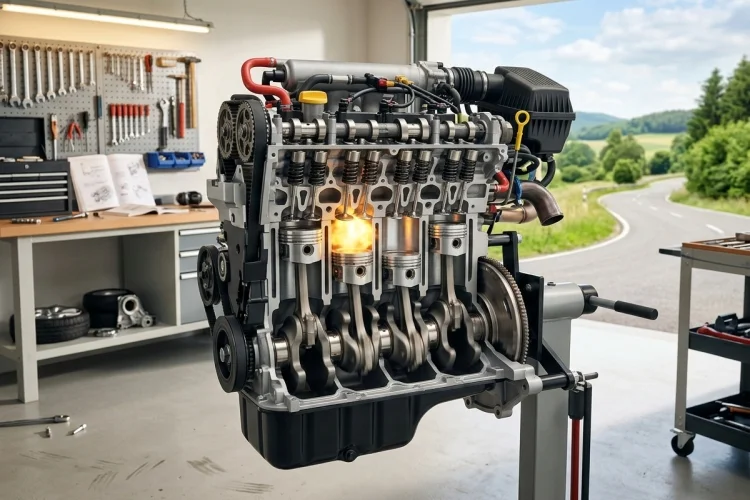
Have you ever pressed the accelerator and wondered what is happening under the bonnet? A car engine may look like a confusing collection of metal parts, pipes, belts, and wires, but its main purpose is simple: it turns the chemical energy stored in fuel into movement.
Most petrol and diesel cars use an internal combustion engine. This means fuel burns inside the engine, creating pressure that pushes pistons. Their up-and-down motion turns a crankshaft, producing the rotation that eventually drives the wheels.
So, how does a car engine work step by step? This beginner’s guide explains the four-stroke cycle, the most important engine components, how power reaches the road, and why oil and coolant matter.
You do not need an engineering background. Think of the engine as an air pump, fuel burner, and motion converter working together at very high speed.
What Is the Main Job of a Car Engine?
A conventional car engine converts fuel into rotational force. Inside it, pistons move through sealed cylinders, while connecting rods join those pistons to the crankshaft.
As combustion pushes a piston downward, the crankshaft turns-similar to the way your legs rotate the crank on a bicycle.
That rotating force is called torque. It passes through the transmission and drivetrain before reaching the wheels. In simple terms, the engine creates rotation, while the transmission controls how that rotation is used at different vehicle speeds.
Essential Engine Components
The cylinders are the chambers where combustion takes place. Intake valves let fresh air enter, exhaust valves release burned gases, and a camshaft opens each valve at the correct moment.
Petrol engines use spark plugs to ignite the compressed air-fuel mixture. Diesel engines compress air until it becomes hot, then inject fuel that ignites under the high temperature and pressure.
How the Four-Stroke Engine Cycle Works
Most modern car engines operate on a four-stroke cycle. One complete cycle uses four piston strokes and two crankshaft rotations: intake, compression, power, and exhaust.
1. Intake
The intake valve opens and the piston moves downward, drawing air into the cylinder. Depending on the fuel system, petrol may enter through the intake port or be injected directly into the cylinder.
2. Compression
The valves close and the piston moves upward. This squeezes the air-fuel charge into a smaller space, preparing it for efficient combustion.
3. Power
Near the top of the cylinder, a spark plug ignites the mixture in a petrol engine. Expanding gases force the piston downward, creating useful power and turning the crankshaft.
4. Exhaust
The exhaust valve opens and the piston rises, pushing burned gases out of the cylinder. The cycle then begins again almost immediately.
Each cylinder in a four-stroke engine produces one power stroke for every two crankshaft rotations. For example, a four-cylinder engine running at 3,000 revolutions per minute completes approximately 6,000 power strokes per minute across all four cylinders.
How Fuel, Air, and Electricity Work Together
An engine needs air, fuel, compression, and correctly timed ignition. The intake system pulls air through a filter, while the fuel system supplies a carefully measured amount of petrol or diesel.
Sensors continuously send information to the engine control unit, commonly called the ECU. This computer adjusts fuel delivery, ignition timing, airflow, and other functions according to engine temperature, speed, load, and driving conditions.
Modern vehicles use fuel injection instead of traditional carburettors. Direct injection sprays fuel into the combustion chamber, while port injection delivers it into the intake path.
According to a U.S. Department of Energy dataset, gasoline direct injection appeared in 73% of light-duty vehicles produced for the 2023 model year.
The battery supplies electricity to the starter motor when the driver turns the key or presses the start button. Once the engine is running, the alternator generates electricity for the vehicle and helps recharge the battery.
How Engine Power Reaches the Wheels
The crankshaft may be spinning, but the car still needs a controlled way to use that movement. Rotation passes through a flywheel or flexplate to the transmission, which provides different gear ratios.
Lower gears multiply torque, making it easier for the vehicle to pull away, climb a hill, or accelerate. Higher gears allow the car to travel faster while keeping the engine at a more economical speed.
Power then travels through drive shafts and differentials to the driven wheels. Front-wheel-drive cars send power to the front wheels, rear-wheel-drive vehicles send it to the back, and all-wheel-drive systems can distribute power between both ends.
Not all energy from fuel becomes wheel movement. Some is lost through friction, cooling, pumping work, and exhaust heat. The Department of Energy states that a typical internal combustion engine can lose around 30% of its chemical energy through hot exhaust gases alone.
Why Cooling and Lubrication Matter
Combustion and friction create a significant amount of heat. Without an effective cooling system, engine parts could expand excessively, oil could deteriorate, and serious mechanical damage could occur.
Most cars circulate coolant through passages inside the engine. The liquid absorbs heat and travels to the radiator, where airflow removes that heat before the coolant returns to the engine.
A thermostat regulates the flow to help the engine reach and maintain its intended operating temperature.
Engine oil performs a different but equally important job. An oil pump moves filtered lubricant through passages leading to bearings and other moving components.
The oil creates a protective film that reduces metal-to-metal contact, limits friction, and carries away some heat. Without sufficient oil pressure, internal components can wear or fail very quickly.
This is why an oil-pressure warning, rising temperature gauge, or coolant alert should never be ignored.
Petrol vs Diesel Engines
Petrol and diesel engines share the same basic piston-and-crankshaft principle, but they ignite fuel differently.
A petrol engine normally mixes fuel with air and uses spark plugs to begin combustion. It often operates smoothly and can reach relatively high engine speeds.
A diesel engine compresses air more strongly and injects fuel into the hot compressed air. The heat and pressure cause the fuel to ignite, so diesel engines do not normally require spark plugs for combustion.
Diesel engines are generally known for producing strong torque at lower engine speeds, which can be useful for towing and carrying heavy loads.
However, actual power, fuel economy, noise, and emissions depend on the engine’s design, size, turbocharger, transmission, and emission-control technology.
What Engine Size and Turbocharging Mean
Engine size, usually expressed in litres, refers to the total displacement of all the cylinders. A 2.0-litre engine displaces approximately two litres of volume as its pistons move through their strokes.
A larger engine can usually take in more air and burn more fuel, but size alone does not determine performance. A small turbocharged engine may produce more power than a larger naturally aspirated engine.
A turbocharger uses the flow of exhaust gases to spin a turbine connected to a compressor. The compressor forces additional air into the cylinders, allowing the engine to burn more fuel and generate stronger output.
Modern engines may combine turbocharging with direct injection, variable valve timing, and electronic controls. These technologies allow manufacturers to improve power and fuel economy without relying only on larger engine displacement.
Simple Ways to Help Your Engine Last Longer
You do not need to be a mechanic to protect your engine. Use the oil grade listed in the owner’s manual, follow the recommended service schedule, and check the oil and coolant levels regularly.
Coolant should normally be checked only when the engine is cold. Opening a pressurised cooling system while it is hot can release dangerously hot liquid and steam.
Pay attention to changes in sound, smell, temperature, smoke, or performance. Knocking noises, persistent warning lights, blue exhaust smoke, rough running, or repeated overheating deserve professional inspection.
Avoid pushing a cold engine too hard, repair leaks early, and replace air and oil filters when required. Because engine designs and service intervals vary, the owner’s manual for your exact vehicle should always be your primary maintenance guide.
So, how does a car engine work? It draws in air, compresses it, burns fuel to push pistons, and removes exhaust gases. The pistons turn a crankshaft, the transmission manages that rotation, and the drivetrain delivers force to the wheels.
Fuel injection, sensors, cooling, lubrication, and electrical systems keep the process controlled and reliable. Once you understand the four-stroke cycle and the main components, the machinery under the bonnet becomes much less mysterious.
Next time you start your car, picture thousands of carefully timed movements happening every minute. Read your owner’s manual, learn where the oil and coolant reservoirs are located, and make basic maintenance part of your driving routine.