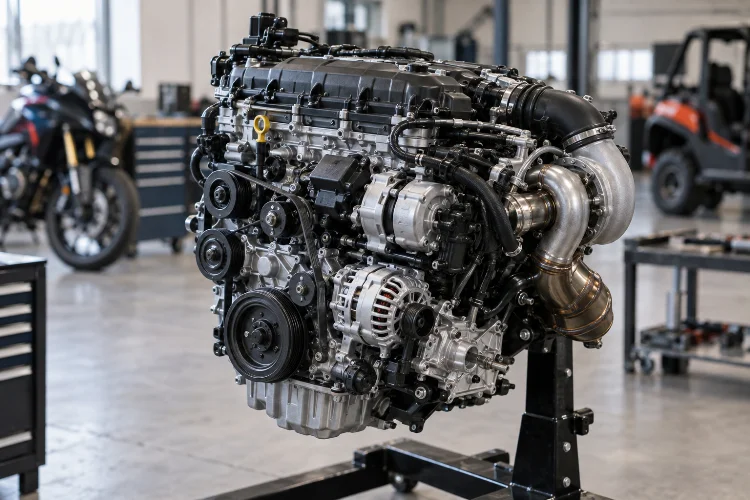
You probably interact with an internal combustion engine more often than you realize. Cars, motorcycles, generators, lawn equipment, trucks, boats, and even some industrial machines still rely on this technology every day.
Although electric motors are receiving more attention as transportation becomes increasingly electrified, internal combustion engines remain an important part of modern engineering.
They have powered transportation and machinery for well over a century and continue to evolve through technologies such as turbocharging, direct injection, variable valve timing, and hybrid systems.
For beginners, however, engines can seem confusing. Terms such as pistons, cylinders, compression ratios, crankshafts, and combustion chambers may sound like something only mechanics need to understand.
The good news is that the basic idea is surprisingly simple.
This guide to Internal Combustion Engines: Everything Beginners Should Know explains how these machines turn fuel into movement, the major engine types, their important components, efficiency, emissions, maintenance, and where the technology may be heading next.
What Is an Internal Combustion Engine?
An internal combustion engine, commonly shortened to ICE, is a machine that converts chemical energy stored in fuel into mechanical energy.
The important word is internal. Combustion takes place inside the engine itself, usually within cylinders.
When fuel burns, rapidly expanding gases create pressure that pushes a piston. The piston transfers that force through connecting rods to a crankshaft, producing rotational motion.
That rotation can eventually turn a vehicle’s wheels, drive a generator, operate a water pump, or power industrial machinery.
According to the U.S. Department of Energy, modern automotive internal combustion engines generally fall into two major categories: spark-ignition engines, commonly associated with gasoline, and compression-ignition engines, normally associated with diesel fuel.
How Does a Four-Stroke Engine Work?
Most gasoline and diesel engines used in modern vehicles operate using a four-stroke cycle. A piston moves up and down inside a cylinder while valves control the flow of gases.
1. Intake Stroke
The piston moves downward, creating space inside the cylinder.
In a gasoline engine, air and fuel-or sometimes primarily air before direct fuel injection-enter the combustion chamber. Diesel engines usually draw in air before fuel is injected later.
2. Compression Stroke
The piston moves upward and compresses the contents of the cylinder.
Compression is important because it allows the combustion process to release energy more effectively. Diesel engines generally operate with higher compression ratios than gasoline engines.
3. Power Stroke
Now comes the part that actually produces useful power.
In a gasoline engine, a spark plug ignites the compressed air-fuel mixture. In a diesel engine, fuel injected into highly compressed, hot air ignites without requiring a conventional spark plug.
The resulting combustion pushes the piston downward.
4. Exhaust Stroke
Finally, the piston moves upward again while the exhaust valve opens.
Burned gases leave the cylinder through the exhaust system, and the entire cycle begins again. These four processes-intake, compression, power, and exhaust-repeat extremely quickly while an engine is running.
Gasoline vs. Diesel Engines: What Is the Difference?
Gasoline and diesel engines share many mechanical components, but they ignite fuel differently.
A gasoline engine normally uses spark ignition. The air-fuel mixture is compressed inside the cylinder before a spark plug creates the spark that starts combustion.
Diesel engines use compression ignition. Air is compressed so strongly that its temperature rises dramatically. Diesel fuel is then injected into the hot compressed air, causing it to ignite.
This difference affects performance.
Diesel engines typically operate at higher compression ratios and are often more fuel-efficient, especially under heavy loads.
A U.S. Department of Energy technical primer noted approximate fuel-to-useful-work efficiencies of 40-50% for diesel engines compared with roughly 25-35% for gasoline spark-ignition engines, although real-world effeciency varies significantly with engine design and operating conditions.
Gasoline engines, meanwhile, are commonly lighter, smoother, quieter, and capable of reaching higher engine speeds.
Main Components Inside an Internal Combustion Engine
An engine may contain hundreds of individual parts, but beginners only need to understand a few major components.
The cylinder provides the chamber where the piston moves. The piston receives pressure from combustion, while the connecting rod transfers its movement to the crankshaft.
The crankshaft converts the piston’s up-and-down motion into rotation.
Meanwhile, the camshaft and valves manage intake air and exhaust gases. Spark plugs ignite gasoline mixtures, while fuel injectors precisely control how fuel enters the engine.
Engines also require supporting systems.
An oil system reduces friction between moving components, while the cooling system prevents excessive temperatures. The air intake, exhaust, fuel delivery system, sensors, and engine control unit all help the engine operate properly.
Modern engines therefore combine traditional mechanical engineering with increasingly sophisticated electronics.
Engine Size, Horsepower, Torque, and RPM Explained
Engine specifications can look confusing when you first encounter them.
Engine displacement describes the combined volume swept by all the pistons and is normally expressed in liters or cubic centimeters. A 2.0-liter engine, for example, has approximately two liters of total displacement.
Bigger displacement once usually meant more power, but that relationship is no longer so simple.
Turbochargers can force additional air into smaller engines, allowing manufacturers to generate considerable power without dramatically increasing displacement.
Horsepower generally describes how quickly an engine can perform work, while torque describes rotational force. Engines producing strong torque at lower RPM can feel especially powerful when accelerating or carrying heavy loads.
RPM means revolutions per minute and indicates how quickly the crankshaft is rotating.
Modern engine design tries to balance all these factors rather than simply maximizing one measurement.
How Efficient Are Modern Combustion Engines?
A combustion engine cannot convert all the chemical energy in fuel into movement.
A considerable amount becomes heat. Energy can also be lost through exhaust gases, cooling systems, friction, pumping losses, and mechanical accessories.
Engineers have therefore spent decades improving thermal efficiency.
Technologies such as direct fuel injection, turbocharging, cylinder deactivation, variable valve timing, improved combustion control, and advanced transmissions can reduce wasted fuel.
One sign of how widespread these technologies have become is gasoline direct injection.
According to U.S. Department of Energy data based on the EPA Automotive Trends Report, about 73% of U.S. light-duty vehicles produced for model year 2023 used gasoline direct injection, while turbocharging appeared on around 37%.
Hybrid systems can improve efficiency further by allowing an engine to operate in more favorable conditions while an electric motor handles situations where combustion engines are less efficient.
Internal Combustion Engines and Emissions
Burning fuel produces more than useful energy.
Vehicle combustion produces carbon dioxide, while engines can also emit pollutants such as nitrogen oxides, carbon monoxide, hydrocarbons, and particulate matter. The exact emissions depend on fuel type, combustion conditions, engine design, and exhaust-treatment technology.
Modern vehicles use several systems to reduce these pollutants.
Catalytic converters can transform harmful exhaust compounds into less harmful substances. Diesel particulate filters capture soot particles, while selective catalytic reduction systems can reduce nitrogen oxide emissions in many diesel applications.
Engine control computers also continuously adjust variables such as ignition timing, fuel injection, air intake, and emissions equipment.
These improvements mean today’s combustion engines can be dramatically cleaner than engines produced decades ago.
However, carbon dioxide from burning fossil fuels remains an important enviroment concern, especially as governments and manufacturers work toward lower-emission transportation.
Why Engine Maintenance Matters
Even a well-designed engine depends on proper maintanance.
Engine oil gradually becomes contaminated and loses some of its protective properties. Filters become dirty, spark plugs wear, cooling systems deteriorate, and belts or hoses can eventually fail.
Ignoring these components can reduce efficiency and cause expensive damage.
Beginners do not need to become professional mechanics, but understanding basic maintenance can make vehicle ownership easier.
Follow the manufacturer’s oil-change schedule, monitor coolant levels, replace filters when required, and investigate unusual sounds, warning lights, smoke, or sudden changes in fuel consumption.
Owners should also use the correct engine oil and recommended fuel.
A modern engine relies on precise tolerances and computer-controlled systems. Using incorrect fluids or repeatedly delaying service can gradually create problems that are much more expensive than routine maintenance.
Do Internal Combustion Engines Still Have a Future?
Electric vehicles are changing the transportation industry, but combustion engines are unlikely to disappear immediately.
Millions of existing cars, trucks, motorcycles, ships, generators, agricultural machines, and industrial systems still depend on them. Some newer vehicles also combine combustion engines with electric motors through hybrid and plug-in hybrid powertrains.
Engine development has not completely stopped either.
Researchers continue exploring cleaner combustion strategies, improved fuels, better thermal management, advanced materials, and more effective emission-control technologies.
The Department of Energy has studied approaches such as low-temperature combustion and lean-burn strategies to improve performance while reducing pollutants.
The long-term transportation market may contain several technologies rather than one universal solution.
Battery-electric systems may dominate certain applications, while hybrids or specialized combustion engines could remain practical elsewhere.
Understanding how ICE technology works is therefore still useful for drivers, automotive students, engineers, and anyone curious about machines.
Internal combustion engines may look complicated from the outside, but their basic principle is straightforward: burn fuel, create pressure, move a piston, and convert that movement into rotational power.
Once you understand the four-stroke cycle, the difference between gasoline and diesel engines, and components such as pistons, crankshafts, valves, and injectors, engine technology becomes much easier to understand.
Modern engines are also far more sophisticated than older designs. Electronic controls, turbocharging, direct injection, hybridization, and emissions equipment help manufacturers recieve more useful performance from every unit of fuel.
If you are learning about cars or mechanical engineering, start with these fundamentals. Then explore topics such as turbochargers, compression ratios, fuel injection, engine cooling, lubrication, and hybrid powertrains to build a deeper understanding.