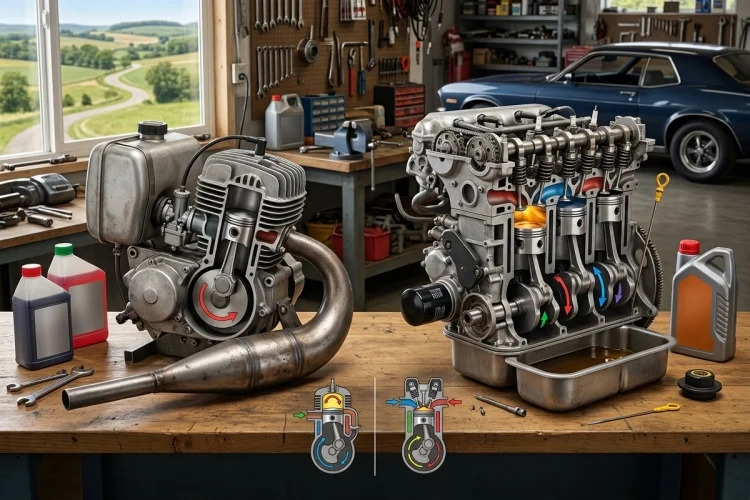
Two-stroke and four-stroke engines can both turn fuel into motion, but they complete the job in very different ways.
One is compact, light, and capable of producing frequent bursts of power. The other uses a longer operating cycle that generally provides cleaner, smoother, and more efficient performance.
Understanding two-stroke vs four-stroke engines is useful when choosing a motorcycle, outboard motor, chainsaw, generator, lawn machine, or other petrol-powered equipment.
It also explains why you may need to mix oil into the fuel for one machine but pour oil into a separate reservoir for another. The main difference is the number of piston movements required to complete one combustion cycle.
A two-stroke engine completes its cycle in two piston strokes and one crankshaft revolution. A four-stroke design requires four piston strokes and two crankshaft revolutions.
That simple difference affects power delivery, weight, fuel use, lubrication, emissions, noise, and maintenance.
How Does a Two-Stroke Engine Work?
A two-stroke engine combines several stages of the combustion process. It completes intake, compression, combustion, and exhaust within one upward and one downward movement of the piston.
As the piston travels upward, it compresses the air-fuel charge in the cylinder. At the same time, a fresh charge is drawn into the crankcase or intake system, depending on the engine’s design.
Near the top of the stroke, a spark plug ignites the compressed mixture. Expanding gases then push the piston downward, creating the power stroke.
As the piston approaches the bottom, it uncovers exhaust and intake or transfer ports in the cylinder wall. Burned gases begin leaving while a fresh charge enters for the next cycle.
Because the process repeats during every crankshaft revolution, a two-stroke engine can produce a power stroke more frequently than a four-stroke engine. Yamaha explains that this frequent combustion contributes to immediate power delivery and a strong power-to-weight ratio.
How Does a Four-Stroke Engine Work?
A four-stroke engine separates its operating cycle into intake, compression, power, and exhaust strokes.
During the intake stroke, the piston moves downward while an intake valve opens. Air and fuel-or air alone in a diesel engine-enter the cylinder.
The intake valve then closes, and the piston travels upward to compress the cylinder charge. In a petrol engine, the spark plug fires near the top of this compression stroke.
Combustion pushes the piston downward during the power stroke. Finally, the exhaust valve opens and the piston rises again, forcing the burned gases out of the cylinder.
The complete sequence requires four piston movements and two crankshaft rotations. The camshaft and valve system must remain synchronised with the crankshaft so that each valve opens at the correct moment.
Power Delivery and Power-to-Weight Ratio
A two-stroke engine produces one theoretical power stroke per crankshaft revolution. A four-stroke engine produces one power stroke every two revolutions.
For example, a single-cylinder two-stroke operating at 3,000 RPM can theoretically complete around 3,000 power strokes per minute. A comparable four-stroke completes around 1,500.
This does not mean every two-stroke is twice as powerful. Actual output depends on displacement, airflow, combustion efficiency, exhaust tuning, RPM, fuel delivery, and mechanical losses.
However, the more frequent power events give two-strokes strong performance for their size and weight. Their simpler construction also eliminates many valve-train components, allowing the engine to be compact.
Four-stroke engines generally deliver smoother and more predictable torque. Their separate intake and exhaust stages give engineers greater control over cylinder filling, combustion, and gas removal.
Modern four-strokes can also use technologies such as variable valve timing, electronic fuel injection, turbocharging, and multi-valve cylinder heads.
As a result, an advanced four-stroke may easily outperform an older or simpler two-stroke despite producing fewer power events per revolution.
Lubrication Is a Major Difference
Many small petrol two-stroke engines do not have a conventional oil sump. Instead, they receive lubrication from oil mixed with the fuel or supplied by a separate oil-injection system.
As the fuel-oil mixture passes through the engine, it lubricates components such as the crankshaft bearings, connecting rod, piston, and cylinder wall. The oil is eventually burned during combustion.
The exact fuel-to-oil ratio depends on the manufacturer. For example, many STIHL machines use a 50:1 petrol-to-two-cycle-oil mixture, but that figure should never be assumed for every engine.
Too little oil can cause overheating, piston seizure, and rapid wear. Too much may increase smoke, deposits, spark-plug contamination, and exhaust blockage.
A four-stroke engine normally stores oil in a sump or crankcase. An oil pump circulates it around bearings, pistons, camshafts, and valve-train components before it returns to the reservoir.
The oil is not intended to burn with the fuel, so it must be checked and changed separately. Using a petrol-oil mixture in a four-stroke engine can cause serious operating problems or damage.
Fuel Economy and Emissions
Traditional two-stroke engines can lose part of their fresh air-fuel charge through the exhaust port during the scavenging process. They may also burn lubricating oil along with the fuel.
These characteristics can increase hydrocarbon, carbon monoxide, smoke, and particulate emissions. EPA research has found much higher toxic organic and particulate emissions from conventional two-stroke outboards compared with four-stroke models.
Four-stroke engines keep the intake and exhaust processes more clearly separated. Their valves provide greater control over when gases enter and leave the cylinder, generally supporting more complete combustion and better fuel economy.
Four-strokes also use a recirculating lubrication system rather than deliberately burning oil during normal operation. This helps explain why they are widely used in modern road vehicles and equipment subject to strict emissions requirements.
Not every two-stroke is automatically inefficient or highly polluting. Direct injection, electronic oil delivery, improved scavenging, catalysts, and other technologies can reduce emissions significantly.
Nevertheless, traditional carburetted two-stroke designs usually have a disadvantage in this area.
Weight, Complexity, and Durability
Two-stroke engines contain fewer major moving components. Many designs do not need camshafts, conventional intake and exhaust valves, timing chains, or valve springs.
This simplicity can make them lighter, cheaper to manufacture, and easier to repair. Yamaha describes its two-stroke outboards as having relatively simple structures and straightforward maintenance.
Low weight is particularly useful in handheld equipment. A powerful engine is less helpful when the user has to carry an excessively heavy chainsaw, trimmer, or leaf blower for several hours.
Four-stroke engines are mechanically more complicated, but they are often designed for sustained, efficient operation. Their dedicated lubrication system and more controlled combustion process can support long service life when maintenance is performed correctly.
Durability still depends on the individual design and how the machine is treated. A well-maintained two-stroke can provide years of reliable service, while a four-stroke operated with insufficient oil may fail quickly.
Maintenance Requirements
Two-stroke maintenance is usually mechanically straightforward, but fuel preparation requires care. Owners must use the correct petrol, two-stroke oil, and mixing ratio unless the machine has an automatic oil-injection system.
Air filters and spark plugs need regular inspection. Carbon deposits may also develop in the exhaust port, silencer, or spark-arrestor screen because lubricating oil is burned with the fuel.
Four-stroke maintenance includes checking and replacing crankcase oil. Depending on the machine, owners may also need to replace an oil filter, inspect valve clearances, and maintain a timing belt or chain.
The valve train adds more parts, but four-stroke owners do not normally need to mix oil with petrol. Fuel goes into the tank, while engine oil is added and serviced separately.
In both cases, the owner’s manual takes priority. Using the wrong lubricant, guessing the mixing ratio, or extending service intervals can shorten engine life.
Where Are Two-Stroke and Four-Stroke Engines Used?
Two-strokes remain useful where compact dimensions and low weight matter. Common examples include chainsaws, brush cutters, leaf blowers, some motocross bikes, snowmobiles, small outboard motors, and specialised racing machines.
They can operate effectively in different positions because many small designs do not depend on oil sitting in a conventional sump. This is valuable for a chainsaw that may be held horizontally, vertically, or at an angle.
Four-strokes dominate modern cars, road motorcycles, large generators, lawn tractors, and many current outboard applications. They are preferred where fuel efficiency, quiet operation, low emissions, and long-distance durability are important.
Yamaha notes that four-stroke engines are now used in most mainstream road-going two-wheelers, reflecting changing demands for cleaner and more economical operation.
Which Engine Type Is Better?
Neither design is automatically better in every situation. The right choice depends on what the engine needs to do.
A two-stroke may be ideal for a lightweight tool that needs strong power without becoming difficult to carry. Its compact construction and quick response can be more valuable than maximum fuel economy.
A four-stroke is often the better choice for road transport, long operating periods, low noise, and reduced fuel consumption. It may weigh more, but its smoother delivery and cleaner operation are usually better suited to daily use.
Purchase price and maintenance habits also matter. A simple two-stroke may cost less initially, but it requires correct fuel-oil preparation. A four-stroke may involve more components and servicing, yet it generally uses less fuel and produces fewer exhaust emissions.
The biggest difference between two-stroke and four-stroke engines is how quickly they complete their combustion cycles. A two-stroke finishes the sequence in one crankshaft revolution, while a four-stroke requires two.
Two-strokes are generally light, simple, and powerful for their size, making them useful in handheld tools and performance applications. Four-strokes tend to be smoother, quieter, more economical, and cleaner, which is why they dominate modern road vehicles.
Before operating either type, identify its lubrication system and read the owner’s manual. Never guess whether oil should be mixed with the fuel.
Choose the engine that matches your workload, maintenance habits, and local emissions rules-not simply the one with the most impressive power figure.