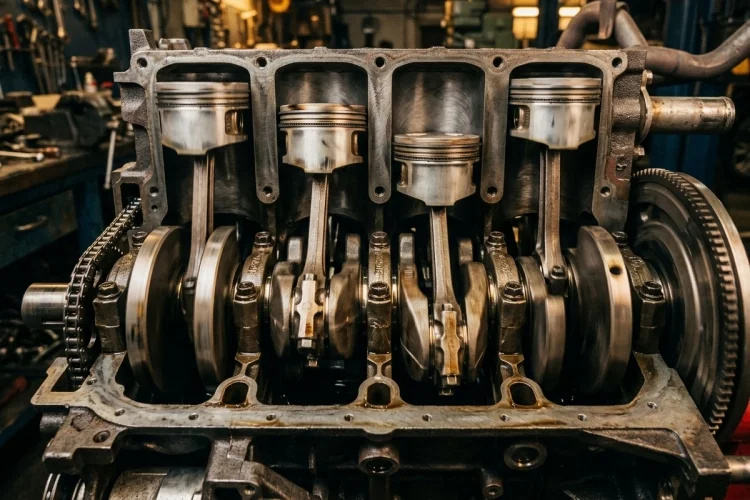
Inside a running engine, the pistons repeatedly move up and down at incredible speed. However, a car’s transmission and wheels need rotational movement, not a collection of metal parts bouncing vertically inside cylinders.
The crankshaft solves this problem. It connects to the pistons through connecting rods and converts their reciprocating motion into continuous rotation. That spinning movement can then pass through the flywheel, transmission, and drivetrain to move the vehicle.
Understanding the crankshaft and how it converts motion makes the entire internal combustion engine easier to understand. It explains how combustion pressure becomes torque, why connecting rods move at changing angles, and why lubrication is essential for engine survival.
The basic principle is similar to pedalling a bicycle. Your legs move through a repeated pattern, but the crank mechanism converts that input into rotation. An engine crankshaft performs a comparable job while handling much greater speed, temperature, and force.
What Is a Crankshaft?
A crankshaft is a strong rotating shaft located in the lower section of an internal combustion engine. It is usually supported inside the engine block by several main bearings.
Each piston connects to the crankshaft through a connecting rod. The upper end of the rod attaches to the piston through a piston pin, while the lower end fits around an offset section of the crankshaft known as a crankpin or rod journal.
When combustion pushes the piston downward, the connecting rod transfers that force to the offset crankpin. Because the crankpin is positioned away from the crankshaft’s central axis, the force causes the entire shaft to rotate.
The crankshaft is one of the engine’s most heavily loaded components. It must handle combustion pressure, the inertia of moving pistons, bending forces, twisting loads, and vibrations created by separate cylinders firing at different times.
How the Crankshaft Converts Linear Motion Into Rotation
A piston can only move in a straight line between the top and bottom of its cylinder. These positions are called top dead centre and bottom dead centre.
The crankpin, however, moves in a circle as the crankshaft rotates. The connecting rod links these two types of movement, changing the piston’s straight travel into circular crankshaft motion.
Imagine pushing down on a bicycle pedal when it is slightly forward of its highest position. Your downward force creates leverage that turns the crank. The piston and connecting rod work in a similar way.
The amount of turning force changes throughout the piston stroke. When the piston is exactly at top dead centre, the connecting rod and crank are almost in a straight line, so very little turning leverage is available.
As the crankshaft rotates beyond that position, the angle of the connecting rod changes and the effective leverage increases. This is why combustion is timed so that strong cylinder pressure acts after the piston begins its downward power stroke rather than reaching its maximum too early.
NASA describes this process as the conversion of linear piston movement into angular crankshaft motion. One complete crankshaft revolution also moves the piston from the top of the cylinder to the bottom and back to the top.
The Main Parts of a Crankshaft
A crankshaft may look like a single irregular piece of metal, but its shape includes several carefully designed sections.
1. Main Journals
The main journals sit along the crankshaft’s central axis. They rotate inside the main bearings that support the shaft within the engine block.
These journals must have extremely smooth surfaces and accurate dimensions. Even a small clearance or lubrication problem can affect oil pressure, bearing life, noise, and crankshaft stability.
2. Crankpins and Crank Throws
Crankpins, also called rod journals, are the offset surfaces where connecting rods attach. The distance between a crankpin’s centre and the crankshaft’s main axis is known as the crank radius or crank throw.
The crank throw determines half of the piston stroke. For example, an engine with an 86-millimetre piston stroke has a crank throw of approximately 43 millimetres.
3. Crank Webs and Counterweights
Crank webs connect the main journals to the offset crankpins. Counterweights are added to help balance the rotating and reciprocating forces produced by the pistons and connecting rods.
They do not eliminate every vibration, but they reduce stress on the bearings and help the engine operate more smoothly. Some engine designs also use separate balance shafts to control vibrations that cannot be managed by crankshaft counterweights alone.
4. Crankshaft Nose and Rear Flange
The front end, or nose, may drive the timing system, oil pump, water pump, alternator, and other accessories through gears, chains, belts, or pulleys.
The rear flange connects the crankshaft to a flywheel in a manual vehicle or a flexplate in an automatic one. This provides the mechanical link between the engine and transmission.
What Happens During the Four-Stroke Cycle?
In a four-stroke engine, one complete combustion cycle requires four piston strokes and two crankshaft revolutions.
During the intake stroke, the crankshaft pulls the piston downward so fresh air or an air-fuel mixture can enter the cylinder. It then pushes the piston upward during compression.
Combustion forces the piston downward during the power stroke, adding energy to the rotating crankshaft. The shaft then pushes the piston upward again to remove burned gases during the exhaust stroke.
Only the power stroke directly supplies useful combustion force. The crankshaft’s momentum, the flywheel, and power strokes from other cylinders help move each piston through the remaining stages.
Consider a four-cylinder engine running at 3,000 revolutions per minute. The crankshaft is rotating 3,000 times each minute, but each cylinder produces one power stroke for every two revolutions.
That means each cylinder completes approximately 1,500 power strokes per minute. Across four cylinders, the engine produces around 6,000 separate power events every minute.
How the Flywheel and Counterweights Smooth Rotation
Combustion does not apply constant force to the crankshaft. Each cylinder delivers a strong pulse during its power stroke, followed by periods when it consumes some energy during intake, compression, and exhaust.
A flywheel helps smooth these changes by storing rotational energy. It continues spinning between combustion events, helping the crankshaft maintain a more consistent speed.
In manual-transmission vehicles, the flywheel also provides the friction surface used by the clutch. Automatic vehicles normally use a lighter flexplate connected to the torque converter.
Counterweights perform a different job. They help balance forces created as pistons and connecting rods accelerate, slow down, stop briefly, and reverse direction.
The crankshaft can also twist slightly between different sections as cylinders fire. Engineers refer to these movements as torsional vibration, and excessive vibration can contribute to fatigue or damage in the crankshaft, pulleys, belts, and gears.
Many engines therefore use a harmonic balancer or torsional damper on the front of the crankshaft. It helps absorb particular vibration frequencies rather than allowing them to travel repeatedly through the shaft.
Why Crankshaft Bearings and Oil Matter
The crankshaft does not simply rotate directly against the engine block. Main bearings support its central journals, while connecting-rod bearings surround the crankpins.
These are usually plain bearings rather than ball bearings. Pressurised engine oil forms a very thin protective film between the bearing surfaces and the rotating journals.
Under normal conditions, the crankshaft effectively rides on this oil film. This prevents continuous metal-to-metal contact while reducing friction and carrying away heat.
MAHLE notes that engine bearings depend on an oil layer to keep the shaft and bearing surfaces separated. Correct oil flow, viscosity, bearing clearance, and surface finish are therefore critical.
If the engine loses oil pressure, that protective film can break down. The bearings may overheat, wear, or attach themselves to the rotating journal, potentially causing the engine to seize.
Journal condition also matters. Crankshaft surfaces must be ground and polished correctly so they support oil-film formation without rapidly wearing the bearings.
Common Signs of Crankshaft-Related Problems
Crankshafts are designed to last for a long time, but lubrication failure, severe overheating, abnormal combustion, incorrect assembly, and excessive engine stress can cause damage.
A deep knocking noise from the lower engine may suggest excessive clearance in a connecting-rod or main bearing. The sound may become more noticeable as engine speed or load increases.
Low oil pressure can also be connected to worn crankshaft bearings because excessive clearance allows oil to escape too easily. However, low pressure can have several other causes, including insufficient oil, a worn pump, or a blocked pickup.
Drivers may also notice strong vibration, metal particles in the oil, irregular crankshaft sensor readings, or difficulty turning the engine. In extreme cases, the crankshaft can bend or crack.
These symptoms do not prove that the shaft itself has failed. Flywheel problems, worn engine mounts, damaged pulleys, piston faults, and other internal issues can create similar signs.
Crankshaft inspection usually requires precise measurement and significant engine disassembly. This is not normally a beginner-level repair, so persistent knocking, falling oil pressure, or severe vibration should be assessed by a qualified technician.
How to Protect the Crankshaft
The most practical way to protect a crankshaft is to maintain the engine’s lubrication system. Use the correct oil specification, replace the oil and filter at the recommended interval, and check the level regularly.
Never ignore a red oil-pressure warning. Continuing to operate the engine without proper lubrication can damage the bearings and crankshaft within a short period.
Avoid repeatedly forcing the engine to work hard before it has warmed up. Cold oil may not flow as quickly, while internal components have not yet reached their normal operating clearances.
Overheating, persistent engine knock, misfires, and excessive modification can also increase crankshaft and bearing stress. Address these issues before they damage the lower part of the engine.
The crankshaft is the component that turns piston movement into useful engine rotation. Combustion pushes each piston, the connecting rod transfers the force, and the offset crankpin creates the leverage needed to rotate the shaft.
Main journals support the crankshaft, counterweights help control vibration, and the flywheel smooths the separate power pulses.
Meanwhile, pressurised engine oil protects the crankshaft journals and bearings from destructive metal-to-metal contact. Understanding this mechanism makes the whole engine feel less mysterious.
Check your oil regularly, respond immediately to oil-pressure warnings, and arrange an inspection when you hear deep knocking or notice severe vibration. Protecting the crankshaft begins with protecting the lubrication system that allows it to rotate.