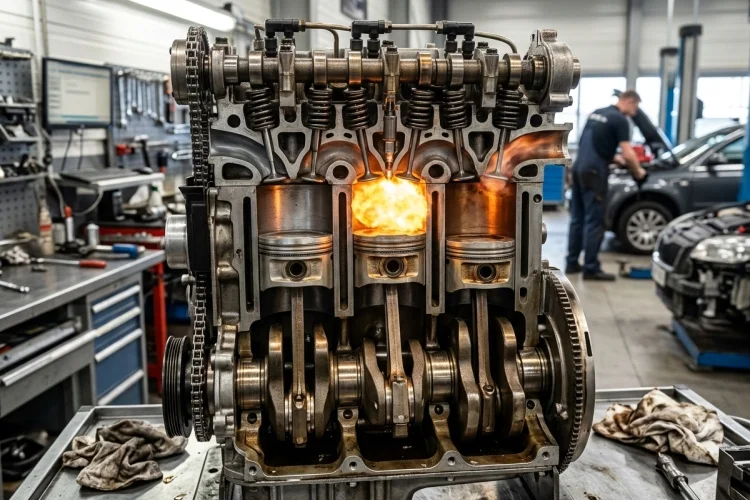
Every time you start a petrol or diesel car, thousands of carefully controlled combustion events begin happening inside its engine. Fuel is mixed with air, compressed, ignited, and converted into pressure that pushes the pistons.
Those moving pistons eventually create the rotation needed to drive the wheels. But how does fuel combustion work inside an engine without damaging everything around it?
Although people often describe combustion as an explosion, normal engine operation is better understood as rapid, controlled burning. The timing, fuel quantity, airflow, temperature, and pressure must all be managed accurately.
In an internal combustion engine, fuel burns inside enclosed cylinders. The resulting hot gases expand and push against a piston, which turns the crankshaft through a connecting rod. The engine therefore converts some of the fuel’s chemical energy into mechanical work.
Understanding this process makes concepts such as fuel injection, spark timing, compression, engine knock, efficiency, and exhaust emissions much easier to follow.
What Does Fuel Combustion Mean?
Combustion is a chemical reaction between fuel and oxygen that releases heat. In a car engine, oxygen comes from the air entering through the intake system.
Petrol and diesel contain hydrocarbons-molecules mainly made from hydrogen and carbon. During ideal combustion, these molecules react with oxygen and produce carbon dioxide, water vapour, and heat.
Real engine combustion is never perfectly ideal. The process happens extremely quickly, temperatures vary across the combustion chamber, and fuel may not mix evenly with every part of the incoming air.
The heat released during burning causes the gases inside the cylinder to expand. This expansion raises cylinder pressure and pushes the piston downward during the power stroke.
The connecting rod transfers that force to the crankshaft, turning straight piston movement into rotation.
How the Engine Prepares the Air-Fuel Charge
Before combustion can begin, the engine must deliver the correct amount of air and fuel. Air enters through a filter and travels through the intake system toward the cylinders.
The fuel-injection system then measures and sprays fuel into either the intake port or the combustion chamber. Port injection places fuel near the intake valve, while gasoline direct injection sprays it directly into the cylinder.
The injector breaks liquid fuel into very small droplets. This process, called atomisation, increases the surface area of the fuel and helps it mix with air and evaporate more effectively.
For conventional gasoline, a commonly cited chemically balanced mixture is approximately 14.7 parts air to one part fuel by mass. This is known as the stoichiometric air-fuel ratio, although the exact value varies with fuel composition and ethanol content.
A mixture containing proportionally more fuel is described as rich. A mixture containing more air is lean. Engines may deliberately move away from the chemically balanced ratio under certain conditions, such as cold starting, hard acceleration, fuel-saving operation, or component protection.
Compression and Ignition Start the Process
Most car engines use a four-stroke cycle: intake, compression, power, and exhaust. During one complete cycle, the piston moves four times while the crankshaft completes two full rotations.
During the intake stroke, the piston moves downward and fresh air enters the cylinder. In many petrol engines, fuel is added before or during this stage.
The intake valve then closes, and the piston travels upward during the compression stroke. This squeezes the cylinder charge into a much smaller space, raising its pressure and temperature.
In a petrol engine, the spark plug fires near the end of compression. The spark creates a small initial flame that begins burning the surrounding air-fuel mixture.
NASA describes this ignition as the start of a rapid combustion process that releases heat and produces expanding exhaust gases.
The spark usually occurs slightly before the piston reaches the very top of the cylinder. Combustion takes time, so starting it early helps maximum useful pressure develop just after the piston begins moving downward.
How the Flame Front Produces Engine Power
Once the spark ignites the mixture, a flame front travels outward through the combustion chamber. It burns progressively rather than setting every fuel molecule alight at exactly the same instant.
The speed and shape of this flame are influenced by air movement, fuel quality, cylinder pressure, chamber design, spark-plug location, and mixture strength. Engineers create swirl and turbulence inside the cylinder to help air and fuel mix and burn more consistently.
As combustion continues, temperature and pressure rise rapidly. The expanding gases press against the piston crown, forcing the piston downward during the power stroke.
Only the power stroke directly adds useful energy to the crankshaft. The crankshaft’s momentum and power strokes from other cylinders help each piston complete its intake, compression, and exhaust movements.
Consider a single cylinder in a four-stroke engine running at 3,000 revolutions per minute. Because it produces one power stroke for every two crankshaft rotations, it completes approximately 1,500 combustion events per minute.
In a four-cylinder engine at the same speed, that equals roughly 6,000 combined power strokes every minute. The cylinders fire in a carefully selected order to provide smoother and more continuous rotation.
Petrol and Diesel Combustion Work Differently
Petrol engines are usually classified as spark-ignition engines. Air and fuel are brought together, compressed, and ignited by an electrical spark.
Diesel engines use compression ignition. They normally draw air alone into the cylinder and compress it much more heavily. Diesel fuel is then injected into the hot compressed air, where it ignites without a conventional spark plug.
Diesel combustion depends heavily on how the injected fuel spray mixes with the air. Some fuel begins burning soon after injection, while additional combustion continues as more droplets find enough oxygen.
Modern common-rail systems keep diesel fuel available at high pressure and allow the engine computer to control injection pressure and timing. Several smaller injections may be used during one cycle to improve smoothness, noise, performance, and emissions.
Both petrol and diesel engines ultimately achieve the same result: expanding gases push a piston and turn the crankshaft. Their main difference is how the fuel is introduced and how ignition begins.
What Controls the Quality of Combustion?
The engine control module manages many conditions that influence burning. It adjusts fuel delivery, spark timing, throttle position, and other systems according to engine speed, load, temperature, and sensor readings.
Good combustion requires the right balance. Too little fuel may cause unstable running or misfires, while excessive fuel may waste energy, increase deposits, and produce higher emissions.
Ignition timing must also be accurate. If the spark occurs too late, pressure develops after the piston has already travelled too far downward, reducing useful power. If it occurs too early, cylinder pressure may rise while the piston is still moving upward.
Compression ratio influences efficiency by determining how strongly the charge is squeezed. Higher compression can help an engine extract more work from fuel, but it may also increase the risk of uncontrolled autoignition in petrol engines.
Air temperature matters as well. Cooler air is denser and contains more oxygen within a given volume. Turbocharged engines commonly use intercoolers to reduce the temperature of compressed intake air.
Direct-injection systems provide additional control by spraying fuel directly into the combustion chamber. Bosch states that modern gasoline direct-injection systems can atomise fuel at pressures of up to 350 bar, depending on the application.
Incomplete Combustion, Misfires, and Engine Knock
Combustion does not always happen correctly. When a mixture fails to ignite or burns only partially, the cylinder may misfire.
A misfire can cause rough idling, hesitation, power loss, increased fuel consumption, and a flashing check engine light. Possible causes include faulty spark plugs, weak ignition coils, incorrect fuel delivery, air leaks, or low cylinder compression.
Incomplete combustion may also leave unburned hydrocarbons or create carbon monoxide. High combustion temperatures can contribute to nitrogen-oxide formation, while locally rich areas-especially in diesel combustion-can encourage soot production.
Engine knock is a different problem. In a petrol engine, it occurs when part of the unburned mixture autoignites unexpectedly instead of burning smoothly behind the intended flame front.
This uncontrolled burning creates sharp pressure waves inside the cylinder. Mild knock may cause a metallic pinging sound, while severe or repeated knock can damage pistons, rings, bearings, and other components.
Fuel octane indicates resistance to knocking. Higher-octane petrol can support demanding operating conditions in engines designed to use it, but it does not automatically increase power in an engine calibrated for regular fuel.
Modern engines use knock sensors and electronic controls to reduce ignition advance or boost when abnormal combustion is detected. This protection can prevent damage, although it may temporarily reduce performance.
Fuel combustion inside an engine is a rapid but carefully managed process. Air enters the cylinder, fuel is injected and atomised, the charge is compressed, and ignition releases heat that raises cylinder pressure.
The expanding gases push the piston, allowing the crankshaft to produce useful rotation. Petrol engines normally begin combustion with a spark, while diesel engines ignite injected fuel through the heat of compression.
Air-fuel ratio, ignition timing, temperature, fuel quality, injection, and chamber design all influence how effectively the process works.
To keep combustion healthy, use the recommended fuel, replace filters and spark plugs on schedule, and investigate misfires, knocking, smoke, or warning lights promptly. Check your owner’s manual today and make correct engine maintenance part of your regular car-care routine.